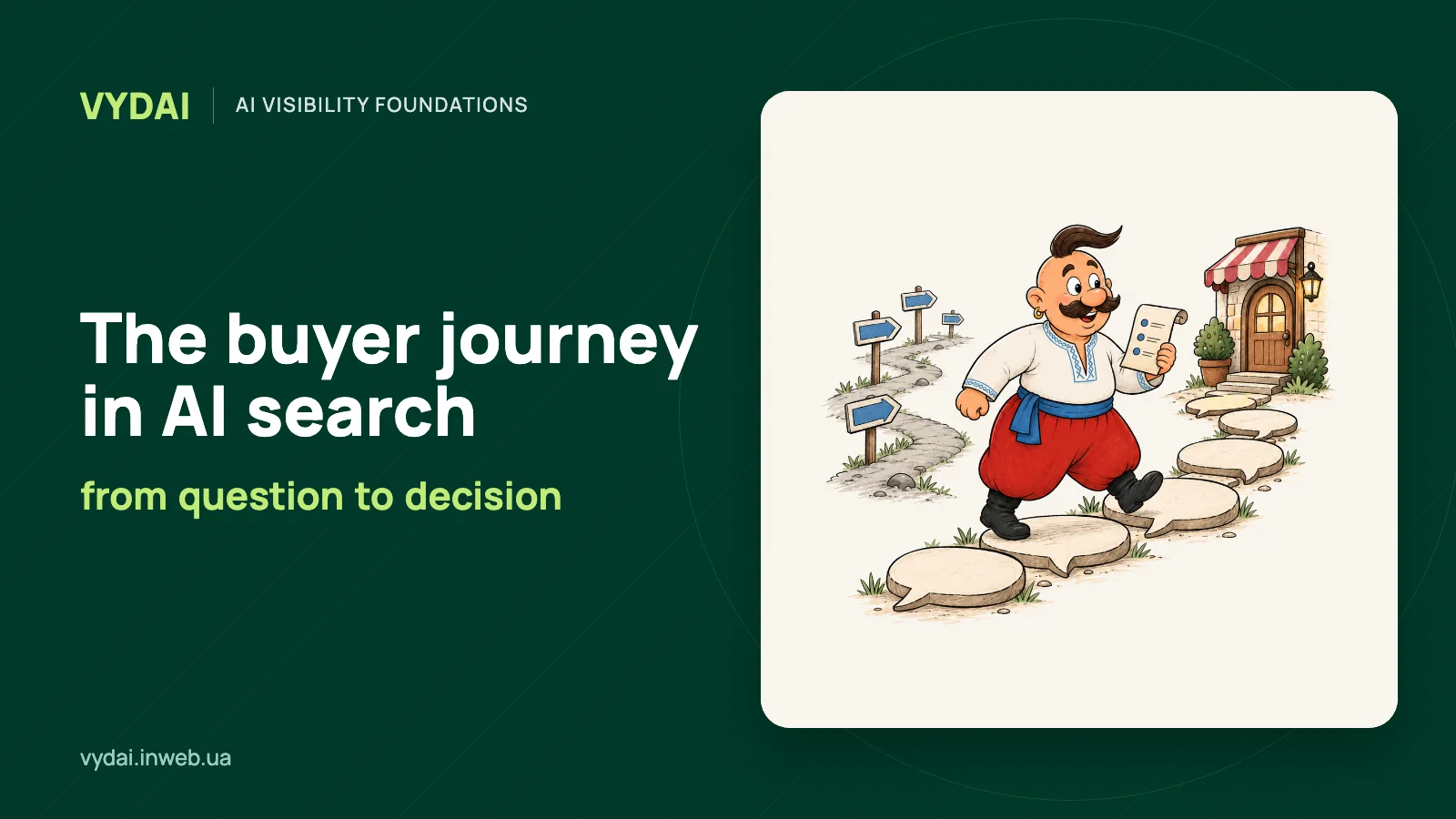
AI search vs Google search can describe different formats within one buyer journey. In an AI answer, a buyer may compare options, build a shortlist, and see cited sources before visiting a website. For example, someone choosing CRM software might ask an assistant to compare integrations, review source links, then visit a vendor site to check its terms. Some clicks may happen later, and others may not be needed once an answer covers the question.
In Google, AI Overviews or AI Mode can appear alongside standard results. In a separate assistant, a buyer can ask follow-ups and open cited links. The route can combine search results and dialogue.
What is conversational search?
Conversational search lets someone ask an initial question, receive an answer with links, and refine it in the same context. It is one search format, alongside traditional result links and AI-generated answers within a search page. OpenAI describes ChatGPT Search as web search with source links and contextual follow-up questions.
As of October 2026, Google says AI Overviews and AI Mode can surface links to sources, while AI Mode supports further research and comparisons. Both features may use query fan-out, which issues related searches across subtopics. Google describes this as a possible technique, not as behavior that applies to every answer. Its documentation on AI features in Search also says there are no special requirements for appearing in these features; the usual SEO fundamentals remain relevant.
Several dated announcements show how these search experiences emerged. Google announced the start of the US rollout of AI Overviews on May 14, 2024, in its announcement of generative AI in Search. OpenAI introduced ChatGPT Search on October 31, 2024, in its product announcement. In 2024, Gartner forecast a 25% decline in traditional search engine volume by 2026. That was a forecast, not a measured result for 2026, as its press release explains.
One buyer journey, different search formats
One buyer journey can include links, an AI answer, a source page, and a follow-up question. These formats shape different next steps.
| Format | What the buyer sees | Possible next step |
|---|---|---|
| Standard Google results | Links to website pages | Opens sources and compares the information |
| Google AI Overviews | A summary and links when Google shows the feature | Reads the summary or opens a source |
| Google AI Mode | An answer with sources for a complex question or comparison | Asks a follow-up or opens a source |
| Conversational assistant | An answer that uses conversation context and may include search links | Continues the conversation or visits a website |
Google and other assistants can show different AI answers and sources. The format also depends on the query. Google Search Central says AI Overviews appear when its systems determine they add value to a particular search.
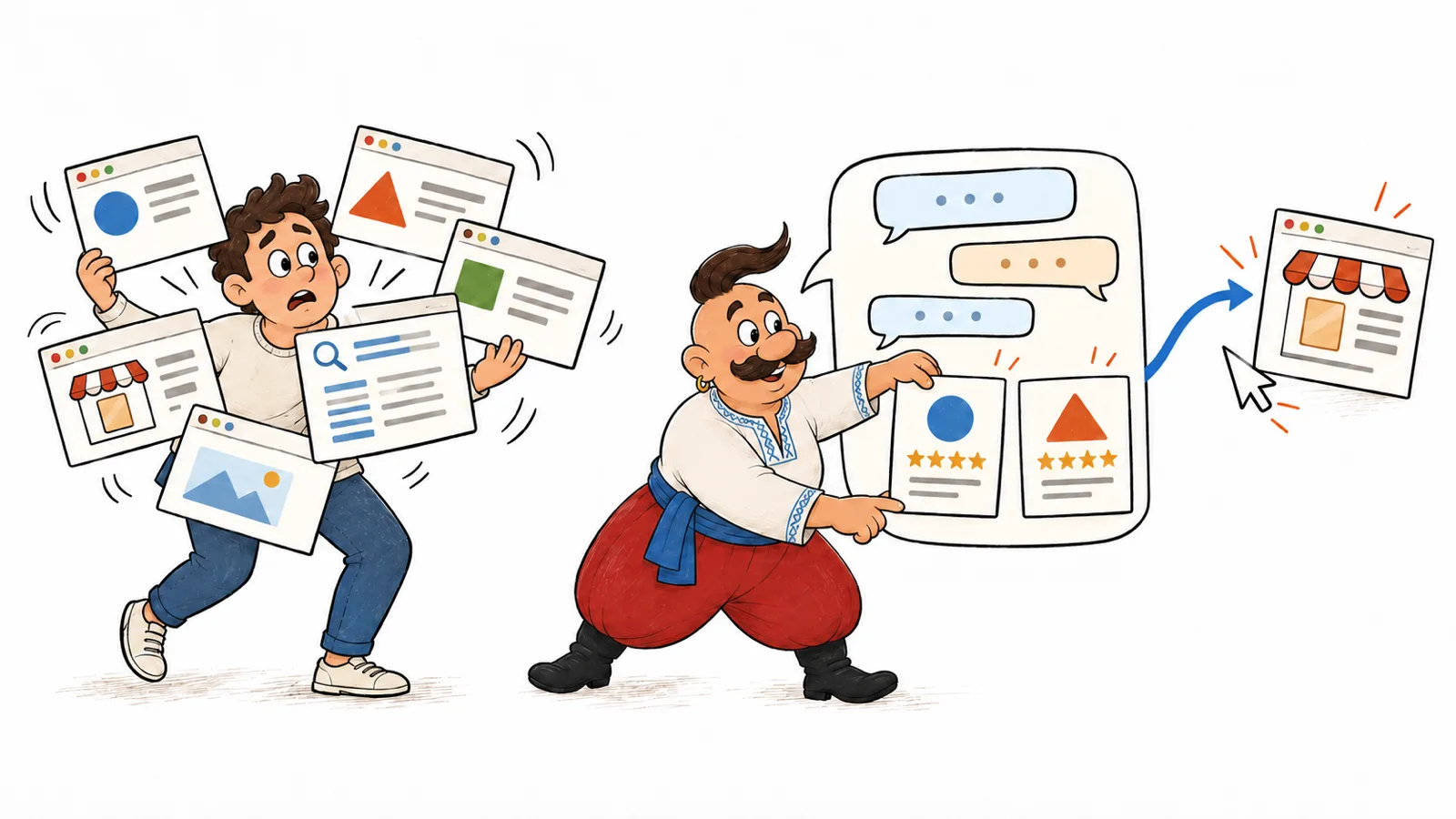
The customer journey in AI search: a hypothetical example
Hypothetical example: a manager at a small B2B team is looking for CRM software with particular integrations. They might review standard search results, ask an AI assistant to compare services, open source links, and verify the product on a vendor’s website. They might also move from Google straight to an overview or provider page.
This is an illustration, not measured customer behavior. It shows which touchpoints to review: the answer, its sources, comparison criteria, and the website information. ChatGPT Search keeps follow-up questions in the chat context; Google’s documentation describes AI Mode for further exploration and complex comparisons.
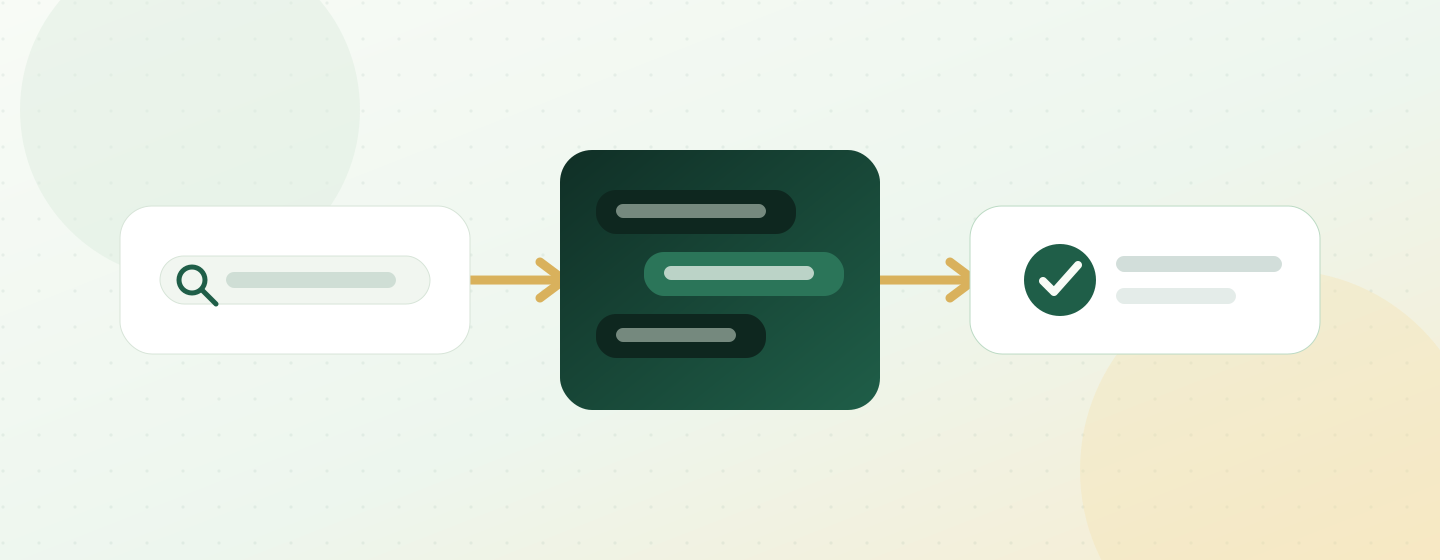
How AI affects the marketing funnel
Different search experiences can influence different moments in a decision, but the journey does not have to follow a fixed sequence. This table is a working model for analysis, not a statistic about how often buyers behave this way.
In Gartner's August to September 2025 survey of 645 B2B buyers, 45% used GenAI mainly to research vendors and products, and 69% preferred validating AI insights with a sales representative; the GEO for B2B and IT companies article follows that journey through vendor selection.
| Decision moment | What to check in search | What to check on the website |
|---|---|---|
| Discovering a need | Whether the brand appears for problem or category queries | Whether the first screen explains the product and who it serves |
| Comparing options | Which alternatives and criteria appear, and which sources are linked | Whether the page provides facts and evidence for comparison |
| Validating a choice | Whether the brand description matches its offer and public sources | Whether the page supports the buyer’s expectations |
| Taking the next step | Whether links lead to a source or provider | Whether a visitor can take a relevant action |
How AI affects the marketing funnel depends on the category, the query, and how someone uses search. Compare your own observations instead of assuming that every buyer follows the same stages. The table shows how AI is changing search at different points in a decision, from discovery to checking a source.
How to adapt content for AI search
As of October 2026, Google does not require separate page formats or special schema.org markup for AI Overviews or AI Mode. Its documentation recommends the same foundations as for regular search: indexing eligibility, useful text, internal links, and structured data that matches visible page content.
Start with buyer questions. Map pages to what someone needs to verify: product details, terms, limits, comparisons, and primary sources. When a page makes claims about features or prices, link to a page where readers can check them. Headings and tables can make information easier for people to find, but they do not guarantee an AI answer will include the page.
Search through AI does not remove the need for SEO. For Google, indexing, accessible text, and useful pages remain relevant. Check these basics before creating pages around assumed prompts.
Keep brand descriptions and sources consistent
When a buyer moves between an AI answer, external sources, and a brand website, they need to understand whether those sources refer to the same product. Check the following:
- Is the product category and audience described consistently on the website and company profiles?
- Can a product claim be checked against a current page?
- Do comparison materials state clear criteria instead of promotional ratings?
- Do older publications link to current pages?
These are editorial checks, not a guarantee that a system will mention the brand. If an answer contains an error, record the query, system, date, and answer link, then verify the source of the claim.
How AI search changes customer behavior
Clicks and organic impressions still help assess search visits. To analyze AI answers separately, define a query set and record what each metric measures.
| Metric | What to count | Limitation |
|---|---|---|
| Mention share | Answers that name the brand among the answers reviewed | Depends on the queries and systems selected |
| Share of voice | Brand mentions compared with named competitors | It is not market share or sales share |
| Query coverage | Topics or query types where the brand appeared | It does not cover every possible buyer query |
| Source citations | Links or sources shown with an answer | A citation is not a visit or conversion |
Google says appearances in AI Overviews and AI Mode are included in Search Console’s overall Web search reporting. GA4 can help analyze activity after a site visit, but website analytics do not reconstruct the buyer’s prior conversation.
For metric definitions, see AI visibility vs SEO: which metrics matter. For the category itself, read what AI visibility means, and for cited materials, see how to analyze sources behind AI answers.
How AI search changes the path to a click
A click can happen right after a search link or after someone has compared information. The timing depends on the query and answer, so a click is not necessarily a late stage.
To understand how AI search changes the path to a click for your audience, compare reviewed answers with site visit data. Record whether the brand had a link, whether someone visited, which page they opened, and what action followed. Do not attribute every traffic change to AI without checking the visit source.
How to review the buyer journey
Start with one real decision scenario. Record the query, date, system, answer, cited sources, and any pages you visit to check its claims. Then repeat the same process for another relevant situation, such as comparing two products.
For your audience, how AI search changes the customer journey is best assessed from its actual questions, not from a general diagram. Compare observations under the same conditions and separate them from assumptions. A log like this will not reveal every buyer action, but it gives the team a shared record of answers and sources. This comparison is one way to see how AI is changing search for your selected scenarios.
If the brand is missing from those answers, check common reasons a brand may not appear in ChatGPT, Gemini, or Claude.
Common analysis mistakes
- Treating every AI answer as a replacement for standard search results. Check which formats appear for the queries you care about.
- Drawing a conclusion about market behavior from one conversation. Record the conditions and repeat the check for relevant scenarios.
- Adding pages or markup only in the hope of appearing in an answer. First check whether the material is accurate and useful to people.
- Treating a mention or citation as proof of a sale. That requires separate visit and conversion data.
Frequently Asked Questions
What is conversational search?
It is a search interaction where someone asks a question, gets an answer, and can continue with follow-ups. ChatGPT Search answers may include links to web sources.
How do AI search and Google search differ?
Google has standard results as well as AI Overviews and AI Mode. Separate assistants may combine dialogue with search and links. The results depend on the query.
How does AI search change a customer's journey?
AI search adds a way to compare options and refine criteria before or after a website visit. Check this against your audience’s queries before drawing a conclusion about the wider market.
How to adapt content for AI search?
Start with Google’s standard SEO requirements and check whether the page answers product questions clearly. Google does not require special markup for AI Overviews or AI Mode.
How can I assess whether AI search changes the path to a click?
Compare answers and their links with site visit data. The result can show whether a search visit followed a linked source, but it cannot explain every action before the visit.
How we do it in VYDAI
In VYDAI, you can set up a query set and review brand mentions, competitors, and sources in answers from ChatGPT, Gemini, Claude, Google AI Overviews, and Google AI Mode. The systems are checked separately, so results describe the selected queries and systems rather than every buyer’s journey.
To review how AI search vs Google search appears across your selected scenarios, create a VYDAI account or view the demo. You choose which queries to check.