To measure AI visibility, use the same real-world prompt set and mark whether each answer mentions the brand, links to its site, or recommends it. Calculate mention share, citation share, and AI Share of Voice with explicit denominators, then track Search Console impressions and clicks alongside GA4 referrals. Put these signals in one report while keeping them in separate rows because each describes a different event.
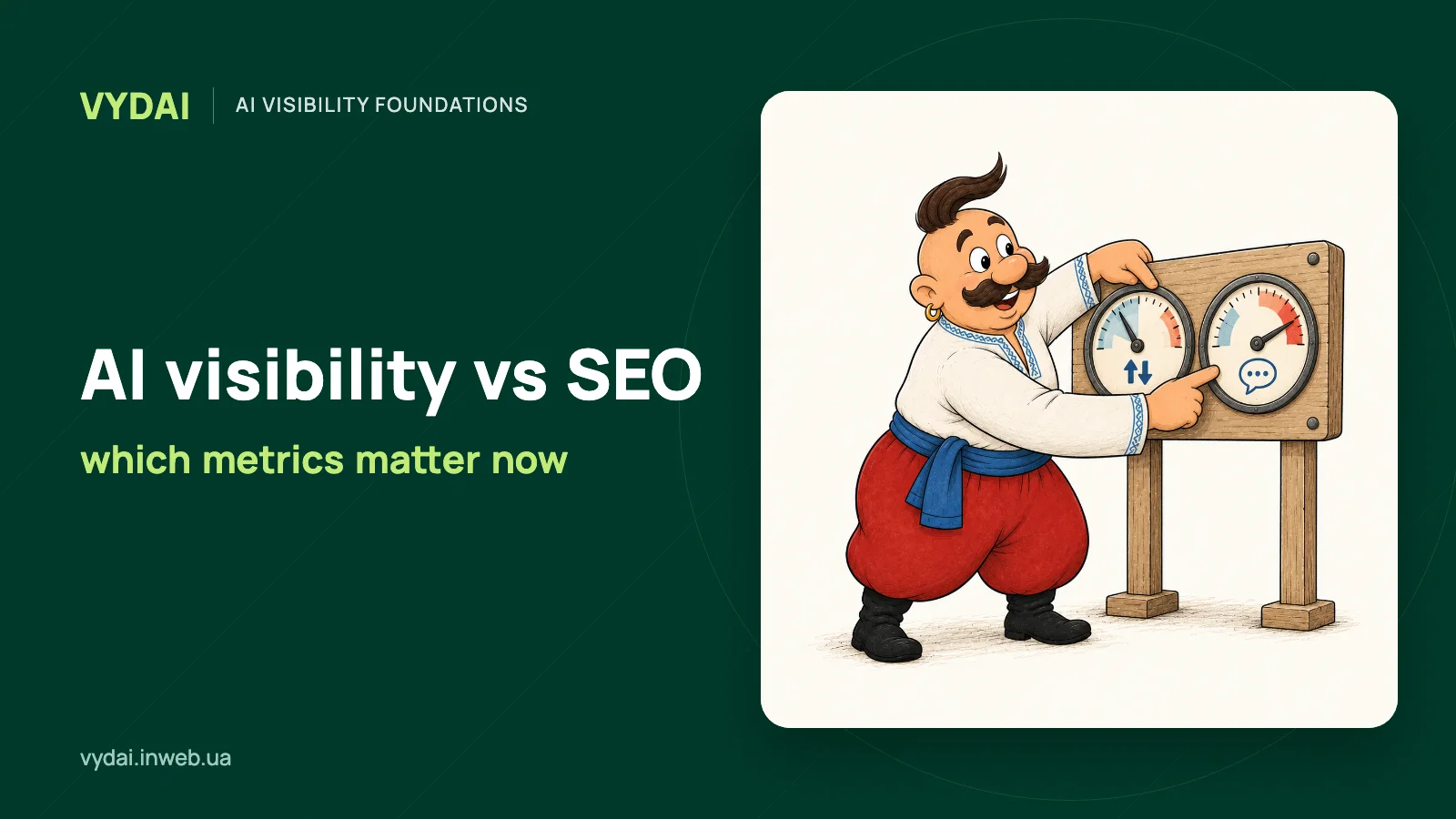
AI visibility vs SEO: which metrics to compare
SEO reports how pages appear in search and how people interact with them. For AI answers, track brand presence, cited sources, the context of a recommendation, and visits to the site separately. These are different observations, so compare them over the same period without combining them into one score.
| Measure | What it shows | Check separately |
|---|---|---|
| Google Search Console impressions and clicks | How pages appear in Google Search and receive clicks | Brand mentions in AI answers |
| Search rankings | A page's position for a query in a specific search tool | Citations of that page in AI answers |
| AI brand mention | Whether a system named the brand in an answer | Links to the site and visits from readers |
| Site citation | Whether an answer named a page or domain as a source | The brand's role: recommendation, comparison, or neutral source |
| Visits from AI services | Sessions that arrived from a recorded source | Mentions and citations in answers that led to no visit |
Google says that a page must be indexed and eligible to appear with a snippet in Google Search to qualify as a supporting link in AI Overviews or AI Mode. That is an eligibility condition, not a promise of citation; Google's documentation on AI features in Search points site owners to the usual search indexing requirements.
Which AI visibility metrics to measure
Start with measures whose unit and denominator you can explain. Record the system, search mode, date, and prompt set; without those details, figures from different periods may not be comparable.
| Metric | How to calculate it | What it can show |
|---|---|---|
| Share of answers with a mention | Answers that mention the brand divided by all checked answers in the sample | How often the brand appears for the selected prompts |
| AI Share of Voice | Brand mentions divided by all brand mentions in the defined sample | How the brand appears alongside competitors in that sample |
| Share of answers citing the site | Answers that name the brand's site as a source divided by all checked answers | How often the site appears among sources |
| Topic coverage | Topics or prompt groups with a brand mention divided by all checked topics or groups | Which parts of the selected subject area include the brand |
| Mention context | Review whether the brand is named, recommended, compared, or only cited | How a mention differs from a recommendation or a source |
These are working definitions for a specific sample. Share of Voice and citation rate can use different denominators across tools, so keep the formula beside every report.
How AI mentions differ from citations
An AI mention means the system named a brand in the answer. A citation means the answer linked to a page or domain as a source. Track recommendation context and site visits as separate fields alongside these signals.
How to calculate AI citation rate
AI citation rate counts answers that cite the brand's domain or a specific page. Record an unlinked brand mention as a mention and tag recommendation context separately. OpenAI's help on web search in ChatGPT explains how to review the sources shown with answers.
Claude web search returns answers with source links when the search tool is used; see Anthropic's web search tool documentation. For a closer look at comparing domains and pages in AI answers, see the guide to analyzing AI sources.
How to measure GEO and AEO results
In GEO and AEO work, these measures concern visibility in AI answers. Track the same separate signals: brand mentions, site citations, answer context, and visits to the site. For definitions of GEO and AEO, see the guide to AI visibility, GEO, and SEO.
AEO metrics for the outcome
Choose measures based on the outcome: count brand mentions for presence, review citations to understand source visibility, and analyze visits and on-site events for business outcomes. To investigate source selection, read the answer context and inspect its linked pages.

A repeatable method for measuring AI visibility
A repeatable method for measuring AI visibility starts with a recorded prompt set. Save the prompt wording, system, search mode, date, answer, brand mention, and cited sources. If the prompt set changes, note that in the report so a sample change is not mistaken for a visibility change. See the guide to choosing prompts for AI visibility monitoring for a process to build a prompt set around real customer situations. For a separate comparison of systems, see how ChatGPT, Gemini, Claude, and Perplexity choose brands. Document the methodology alongside every report. State how to measure AI visibility consistently before interpreting movement between reports.
Keep the raw answers too.
Compare answers to the same prompts in the same systems and with the same settings. Rechecking shows whether an observation recurs; when a change is small, review the raw answers and the sample first. Record the answers themselves, not only a summary number.

A sample record for monthly comparisons
Set the sample boundaries before the first check. Group prompts by user need, record the country and language, and name the systems and answer mode. Then save one row for each checked answer. This lets you return to the evidence behind a change instead of comparing summary percentages alone.
| Sheet field | What to record | Why it helps |
|---|---|---|
| Prompt and topic | Exact wording and intent group | Check whether the prompt mix stayed comparable |
| System and mode | The system and answer mode being checked | Compare the same kind of result |
| Answer | The text or a saved link to the answer | Review mention and recommendation context |
| Brands and sources | Named brands and cited source URLs | Recalculate shares and see which competitors appear |
| Site visit | Session source in GA4, when a session is recorded | Compare answer visibility with measured visits |
When a metric changes, open the rows that produced the change. Check whether answers changed for the same prompts, whether new sources appeared, and whether the sample itself changed. If one topic accounts for the increase, break out the results by prompt group and report that shift separately.
Compare source URLs too: when the same page appears across systems, review that page for currency and completeness. If the brand appears alongside a competitor, open the answer and tag the context as a recommendation, a list of options, or a mention without an evaluation. This takes the team from a metric change to a specific page or prompt to investigate.
Hypothetical example: a monthly measurement sheet
This hypothetical example explains the arithmetic; it is not VYDAI monitoring data or a client result. A sheet can store the month, prompt ID, system, answer, brand mention, cited page, and competitor brands named. A set of 20 prompts checked in 3 systems produces 60 answer checks.
| Measure in the hypothetical example | Calculation | Result |
|---|---|---|
| Share of answers with a mention | 18 answers with a mention / 60 checks | 30% |
| Share of answers citing the site | 9 answers citing the site / 60 checks | 15% |
| AI Share of Voice | 18 brand mentions / 45 mentions of all brands in the answers | 40% |
For Share of Voice, count each brand named in an answer once in that answer; mention and citation shares use checked answers as their denominator. Keep the same prompts and counting rules in the next month, and record the systems and search mode beside the result.
How to combine SEO and AI visibility metrics
Keep SEO data and AI answer measurements in separate rows of a shared report. Compare them by topic or query, without treating one metric as the cause of another. This lets you combine SEO and AI measures while keeping a search position distinct from an AI answer. It also clarifies which data comes from search reporting and which comes from a repeatable prompt-based measurement methodology.
| Question | Data to review | Next step |
|---|---|---|
| Does a page get impressions but few clicks? | Search Console impressions, clicks, and CTR | Check the query, snippet, and page intent |
| Is the brand mentioned but the site not cited? | The AI answer and its listed sources | Find which sources the system used instead of the site |
| Is the site cited but visits are not recorded? | Cited URLs and referral analytics | Check whether the link is clickable and analytics records it |
| Does Google show a page in AI features while other systems do not? | Google's report and separate checks of other systems | Treat each surface as its own channel and keep its data separate |
When an organic position changes, check separately whether mentions, citations, or visits changed; that sequence tells you which evidence to investigate next.
What the Google Search Console AI report measures
As of October 2026, Google calls these Search Generative AI performance reports. Google announced them in June 2026 as a separate view of impressions in generative Search features, including AI Overviews and AI Mode, as well as generative features in Discover. Google's announcement of the Search Generative AI reports.
Use this report to review impressions in Google's generative features. Pair it with separate answer checks in ChatGPT, Gemini, and Claude to record brand mentions and cited sources in those systems.
How to separate AI search referral traffic in analytics
As of October 2026, GA4's Traffic acquisition report includes Session source and Session source / medium dimensions for session sources, as described in Google Analytics help on the Traffic acquisition report. To build a view of AI service referrals, open Explore, create a Free form exploration, add Session source to rows and Sessions to values, then add a session filter or segment for source. Google's GA4 instructions for applying segments and filters in Explorations explain those controls.
Start with this Session source regular expression: chatgpt\.com|perplexity\.ai|gemini\.google\.com|claude\.ai|copilot\.microsoft\.com. These are the current web domains for ChatGPT, Perplexity, Gemini, Claude, and Copilot, checked as of October 2026; OpenAI also confirms that ChatGPT Search referral URLs include utm_source=chatgpt.com. Compare the expression with the actual Session source values in your property and add any variants you find. Since May 13, 2026, GA4 also assigns recognized AI assistant referrals to its own AI Assistant channel (medium ai-assistant), according to the Google Analytics release notes. For the step-by-step setup of that channel, a custom channel group, and the regex, see how to track ChatGPT, Gemini, and Perplexity traffic in GA4.
GA4 can classify a session as direct/(none) when its referral source is missing, for example when source data is not passed or an ad blocker interferes, as explained in Google's guide to direct/(none) traffic. The report therefore captures recorded visits rather than every view of an AI answer: treat referral sessions as the observable subset of traffic, and measure mentions and citations separately.
Common measurement mistakes
- Combining a brand mention, a site citation, a recommendation, and a site visit into one figure.
- Comparing reports with different prompts or settings without noting the sample change.
- Treating a citation as proof of a recommendation; a source can be listed without praise.
- Using a Google position to predict whether a brand will appear in an AI answer.
- Drawing a visibility conclusion from one answer without checking again.
Frequently Asked Questions
How do you measure AI visibility? Record a prompt set and the systems used, then log brand mentions, cited sources, and answer context. Compare those observations across checks and keep them separate from SEO measures.
How do you calculate AI Share of Voice? Define the prompts and brands to compare, count each brand's mentions in the same answers, then divide your brand's mentions by all brand mentions in that sample. Keep the formula with the report.
What is the difference between an AI mention and a citation? A mention names a brand in an answer. A citation identifies a page or domain as a source. A citation can appear without a recommendation, and a mention may have no link.
What performance data does Google's Search Console generative AI report provide? It reports impressions in Google's generative Search and Discover features. Track brand mentions in other AI systems with separate answer checks.
How do you measure AI search referral traffic? Review sessions attributed to AI services in analytics and compare them with tagged referrals where available. The result is observed site visits, while answer checks record mentions and citations.
How we do it in VYDAI
VYDAI shows brand mentions, competitors, and answer sources across five systems: ChatGPT, Gemini, Claude, Google AI Overviews, and Google AI Mode. As of October 2026, this system list matches the product's provider registry. Use Search Console reports and analytics separately for Google's impressions and visits from AI services.
To review your brand data, create an account or open the demo. How to measure AI visibility reliably depends on using a consistent sample and keeping mentions, citations, and visits distinct. A documented methodology also makes the limits of each report easier to explain.