To turn an AI visibility report into an action plan, connect each finding to a specific answer, cited source, or prompt, classify the gap, and assign an owner and a way to check the work. The team can then see why the task is proposed and how to review it after completion.
The report shows where a brand appears in answers, which sources are cited, and which competitors are present. The report does not decide what to change on or off the website. Decisions should follow recorded evidence, not one mention or a general impression.
AI visibility report template: fields to check before planning
Start by checking the evidence. A useful report records the monitored prompts, answer text, system and measurement date, source URLs, and competitor presence. If a field is missing, note that limitation before drawing a conclusion.
| Field | What to check | Why it matters |
|---|---|---|
| Query or prompt | Which scenario was checked and whether it stayed the same | Keeps measurements comparable |
| Answer | Whether the brand is mentioned, recommended, or cited | Separates a brand mention from a source link |
| System and date | Where and when the answer was collected | Records the measurement conditions |
| Sources | Which URLs or domains the answer cites | Helps identify SEO pages or PR sources to review |
| Competitors | Which brands appear in the same scenario | Defines the comparison set |
A metric name without a definition is not enough evidence. Before comparing share of voice, for example, establish the denominator: all answers, answers with recommendations, or another defined set. Record the method beside the result and use the same method in the next measurement.

How to analyze AI brand visibility in four data groups
This article groups the evidence into four areas: prompts, answers, sources, and competitors. The structure helps turn an observation into a finding that can be checked.
- Prompts. Find the scenarios where the brand appears, is missing, or appears in the wrong context.
- Answers. Check how the system describes the brand and whether it recommends it, rather than only mentioning it.
- Sources. Open cited URLs and check whether they support the finding.
- Competitors. Note which brands appear alongside yours and which sources are associated with those mentions.
For each observation, keep the prompt, answer, system, date, and source URL. ChatGPT answers that use web search may include links to sources. As of October 2026, OpenAI says the Sources panel, when available, shows cited sources and other relevant links. OpenAI Help Center guidance on ChatGPT web search and sources.
Keep the raw answer.
Analysis is useful only when you can return to the specific answer and its source. For a closer look at external platforms, see the article on AI trust sources.
Classify each finding before creating a task
The absence of a brand from an answer does not explain the cause. Compare the report with page accessibility, your website content, and the external material cited in the answer. The categories below are a working planning framework, not a diagnosis made by the AI system.
| Gap type | What the report may show | What to check next |
|---|---|---|
| Content | The answer covers a topic that the relevant brand page does not | Whether an existing page needs an update or a new resource is needed |
| Technical or structural | A page exists, but its content may not be accessible or match the scenario | Indexing, crawler access, main text, and internal links |
| External | An answer cites a source where brand information is missing or outdated | Which site is cited and whether its information can be corrected or supplemented |
| Positioning | The brand description conflicts with its category, audience, or offer | Whether owned and external pages describe the brand consistently |
Treat a single answer as a reason to investigate. Before committing significant work, repeat the measurement with the same prompts and record the date and systems. Do not attribute a change to one action unless the evidence lets you distinguish it from normal answer variation.
Build an AI search optimization plan
An AI search optimization plan should connect a confirmed gap to the smallest relevant action. Google says the same foundational SEO practices apply to AI Overviews and AI Mode, and that neither requires special markup. As of October 2026, a page must be eligible for indexing and display in regular Google Search; meeting the requirements does not guarantee that it will appear. Google Search Central guidance on AI features and websites.
SEO tasks may address page access, structure, or whether a page answers the intended query. For Google, check robots.txt, CDN or WAF access, internal links, and whether important content is available as text. Structured data should match the visible page content. Do not add schema on the assumption that it will by itself put a page in AI answers. Google guidance on AI features.
When a task involves markup, choose a type that matches the page. Schema.org defines Product as a product type. Offer can describe an offer to sell, rent, or provide a service. Schema.org definition of Product and Schema.org definition of Offer.
For ChatGPT search, check access for its search crawler. As of October 2026, OpenAI says a site should allow OAI-SearchBot and traffic from its published IP addresses to be eligible for inclusion; placement is not guaranteed. OpenAI requirements for website availability in ChatGPT search.
These checks can inform a generative engine optimization strategy when each action follows from a confirmed issue.
Find content gaps in the report
Build a content plan from report gaps when the evidence points to a specific scenario that your existing pages do not cover. First check whether an existing resource can be improved. Create a new page only when it serves a distinct reader intent.
Compare the prompt with your page and the competitor resource cited in the answer. If a comparison is missing, add selection criteria and current differences. If an answer relies on outdated facts, verify them against the primary source first. Do not create a new article just because a brand is absent from one answer.
For each content task, tie the topic to its prompt, evidence, page to update or create, and a criterion for reviewing the change. This keeps the content plan tied to a real gap and helps distinguish a refresh from a new article.
Turn cited sources into PR tasks
Turn cited-source gaps into PR tasks when repeated answers point to a specific external resource and the brand information there is incomplete or outdated. Treat this as a hypothesis to investigate, not a guarantee that coverage or a mention will change AI answers.
Check the editorial, directory, or review platform's rules. Decide whether the brand can provide accurate information or a relevant expert comment. A PR task based on these findings should name the source and the fact that needs checking. Do not promise inclusion in a roundup or request positive coverage without an editorial reason.
When competitors appear alongside your brand, inspect the prompts and sources separately. Record the answer and cited pages so the team can check whether the pattern repeats.
How to prioritize findings from an AI visibility report
To prioritize AI visibility findings, compare the importance of the scenario, confidence in the evidence, and effort needed to act. ICE is one possible scoring method. GrowthHackers describes Impact, Confidence, and Ease on a 1 to 10 scale and averages them for its own product workflow. This is not a universal standard; a team can use another scale or rank tasks against explicit criteria. GrowthHackers description of the ICE method.
| Criterion | Question for the team |
|---|---|
| Impact | Which important prompts or pages does this action affect? |
| Confidence | What report evidence supports the finding? |
| Effort | Which people and resources are needed to complete the work? |
| Check | Which signal will the team compare afterward? |
Record the reason for each score, not just the number. If the evidence is weak or a task depends on an external platform, leave it for investigation instead of placing it ahead of a confirmed technical issue. For background on AI visibility and how it differs from traditional SEO, see the foundations guide.
Bring tasks into one sequenced plan
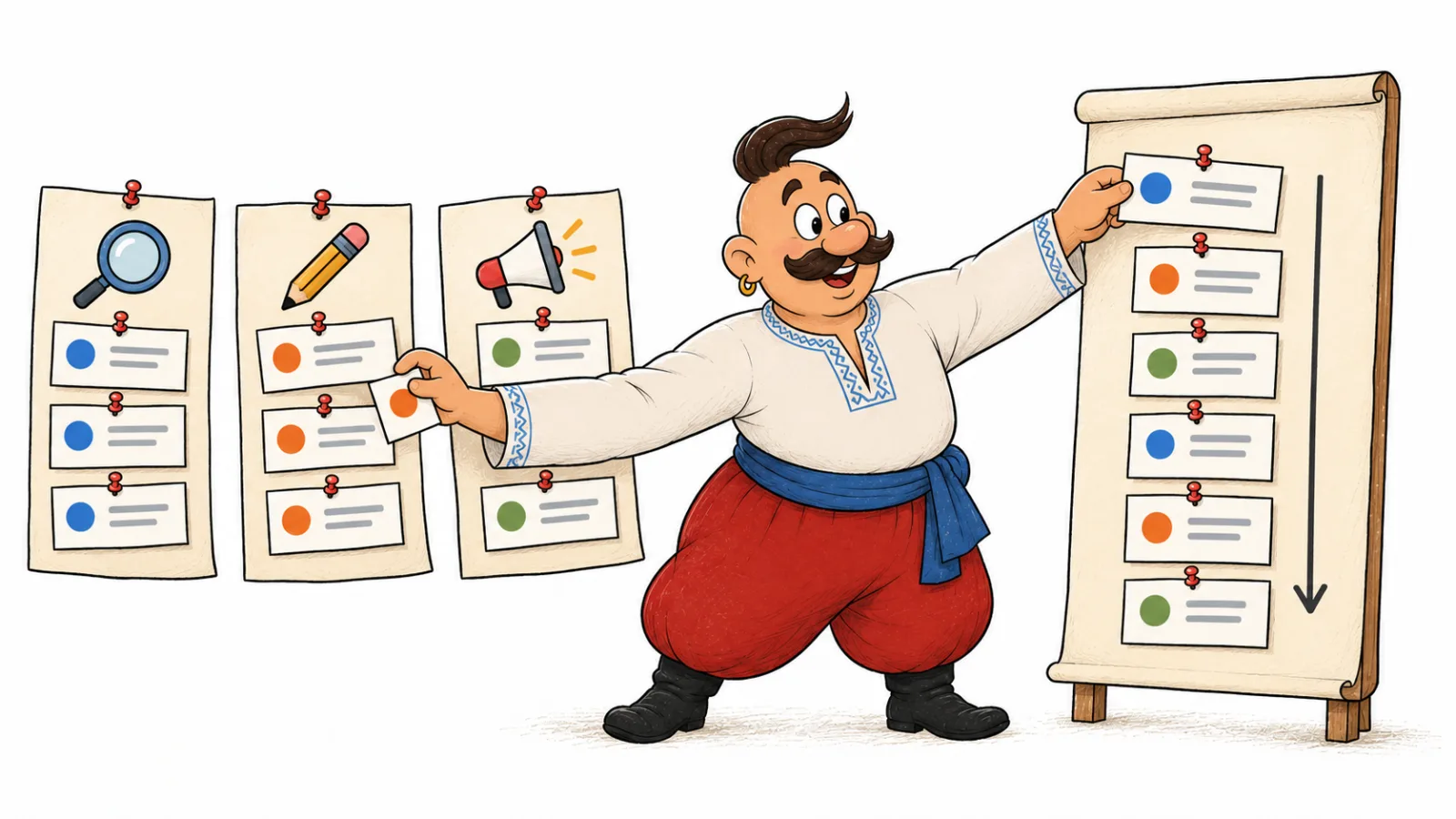
A generative engine optimization strategy for a business, as used here, is a sequence of work based on checked findings. First address a confirmed technical barrier, if one exists. Then update the relevant page or prepare a new resource. Next, plan work with an external source when the report points to one. Set a review date that fits the task timeline and measurement method.
Fill in the task template with evidence
A task card gives the person doing the work enough context to verify the source and understand what completion means. It also helps explain to a manager why the task belongs in the plan.
| Field | What to record |
|---|---|
| Observation | The exact prompt, system, date, and answer excerpt |
| Evidence | The cited page URL or the missing page that prompted the finding |
| Finding and hypothesis | What appears to be wrong and why the proposed action may help |
| Action and owner | The specific change and the role responsible for it |
| Completion criterion | What can be checked on the page after the work |
| Follow-up check | The same prompts and conditions the team will use for comparison |
This is a working template, not a promise of results. If the report lacks an answer, URL, or date, complete the evidence record before assigning the work.
Recheck the same prompt set
After completing tasks, rerun the same prompts and record the measurement conditions. Compare brand mentions, cited URLs, and competitor presence separately. If the system, prompt wording, or collection method changes, record that alongside the result. Do not attribute the difference to one website change without evidence.
Review the prompt pool separately from the fixed comparison set. The article on choosing prompts for AI visibility monitoring explains how to build that pool. Keeping the comparison set stable makes measurements easier to interpret.
Frequently Asked Questions
How to turn an AI visibility report into an action plan? Record the answer and source as evidence, classify the gap, define a specific task, and assign an owner and a follow-up criterion.
What evidence belongs in the report? Prompts, answers, the system and measurement date, cited URLs, and competitor information. Define each metric so comparisons across periods use the same method.
Can I use ICE to compare tasks? Compare the importance of the scenario, the quality of the evidence, and the effort required. ICE can help compare tasks, but a score does not replace source checks or resource planning.
How do I build a content plan from AI visibility gaps? Connect each topic to a specific prompt and evidence. Before creating a new page, check whether an existing one can be improved without mixing separate intents.
When should cited-source gaps become PR tasks? When repeated evidence points to a specific external source that shapes the brand description and the publisher has an appropriate way to update the information.
How we do it in VYDAI
VYDAI shows results by prompt, source, competitor, and AI system. As of October 2026, the product covers ChatGPT, Gemini, Claude, Google AI Overviews, and Google AI Mode. Reviewing answers and sources helps a team check evidence and decide whether SEO, content, or PR work is appropriate. The product does not choose task priorities for the team or guarantee that a brand will appear in an answer.
You can view the workspace by creating an account or opening the VYDAI demo. Your team decides what to do and in what order.