What pages does ChatGPT cite? The DeltaV Digital study found articles, listicles, and product pages among cited sources, while Far & Wide's research described differences across content types. The studies use different samples and systems, so treat their findings as hypotheses to test on your own queries, not as a universal ranking.
For Google's technical eligibility requirements and Search Console reporting, see how to appear in Google AI Overviews and AI Mode.
When a page has been cited
Here, a page citation means a link to a specific URL in an answer or sources list. If a system mentions a brand or domain without a source link, the URL cannot be inferred from the mention alone.
| What happened | What you can record | How to describe it |
|---|---|---|
| An answer with web search shows a URL | The link shown beside the answer or in its sources | A citation to a specific page |
| The answer names a brand but shows no source | The text mention | A brand mention, not a cited URL |
| An API answer has no web sources | The answer text | An answer without a confirmed source URL |
As of October 2026, OpenAI's ChatGPT search help says answers that use web search may include citations, and notes that sources may be incomplete or outdated. Perplexity's help article on how search works describes answers with numbered source links. These are examples of citation interfaces, not a claim that VYDAI monitors Perplexity.
Which website pages appear in AI answers
Use the page types below to check whether a URL answers a particular part of a query. This is not a ranking of citation frequency. Content optimization for GEO starts with matching a page to the user's intent, but no format guarantees that it will appear in an answer.
| Page type | What to check on the page | Query it may answer |
|---|---|---|
| Explainer | Are terms defined, and are the limits of each claim clear? | What is it, how does it work, or how does it differ? |
| Blog post | Does it answer a specific query instead of offering only news or a general opinion? | An explanation, how-to, or specific event |
| Guide or how-to | Can a reader follow the steps and check the result? | How can I do or fix something? |
| Comparison | Are the criteria, conditions, and tradeoffs stated? | Which option should I choose? |
| FAQ | Does each item answer a distinct, specific question? | A follow-up to the main topic |
| Service or product page | Is it clear who the offer is for and what it includes? | A commercial or category query |
| Case study | Can a reader verify its context and reported result? | How did a solution work in a particular situation? |
| Glossary | Is the definition precise and distinct from related terms? | What does a term mean? |
| Category or topic page | Does it help someone evaluate options, beyond navigation? | What options are available in this topic? |
| Research | Are the sample, date, and method described? | What conclusions follow from the data? |
For each URL, ask whether a reader can verify its answer from the page itself. Do not call a page “citable” based only on its format, schema, or length.
What published studies found about page and source types
The studies below count different things: URL types, domains, or sources within a topic-specific sample. They do not combine into one ranking, but they offer testable hypotheses for editorial work.
| Study and date | Systems and sample | Finding about pages or sources | Limitation |
|---|---|---|---|
| DeltaV Digital, July 2026, updated in September | ChatGPT, Perplexity, Gemini, Google AI Overviews, and Google AI Mode; 21,075 responses from April to July 2026 and 25,337 citations across eight industries | No page type dominated the combined sample: articles had 23.7% of citations, listicles 19.6%, and product pages 16.3%. The leading format varied by industry. | Commercially oriented client queries, eight brands, analysis of the most-cited URLs, and automated classification; this was not a random sample of all queries. |
| Far & Wide, April 2026 | ChatGPT with Browse, Perplexity, Google AI Overviews, and Google AI Mode; 40 queries in four categories and more than 170 unique cited URLs collected in March 2026 | The authors compared how-to guides, definitions, comparisons, case studies, and product roundups; the structural traits they reported for cited sources differed by content type. | A small query set and a close review of 14 pages cited by multiple systems; a short snapshot of system behavior. |
| Kai-Cheng Yang, July 2025, preprint | OpenAI, Perplexity, and Google; more than 24,000 conversations, more than 65,000 responses, and more than 366,000 embedded citations in the AI Search Arena dataset | News sources accounted for 9% of citations in the studied corpus; news citations were concentrated among a limited set of outlets. | The analysis covers news sources in an evaluation-platform corpus. The abstract does not specify the full time range or model selection rules. |
| Health source study, January 2026, preprint | ChatGPT 5.2 Pro; a random sample of 100 of 3,173 HealthSearchQA questions produced 615 cited sources | More than 75% of sources in this sample came from established institutional resources, including medical institutions and reference databases. | Health topics only, one assistant, and a sample of 100 questions; the result does not describe other topics or systems. |
For your own site, turn these findings into hypotheses rather than recipes: for an informational query, check an explainer or how-to; for a choice between offers, check a comparison or product page; for a local service, check the homepage; and for health topics, check authoritative institutions. Run the same queries in the systems that matter to you, save the URLs, and see whether that pattern recurs in your topic.
Use content optimization for GEO as an editorial process: check whether the page answers the query, then record the cited URL and date.
What makes a page clear for AI search
These are editorial checks, not published ranking factors. Google's documentation on AI features says a page must be indexed and eligible to appear in Google Search with a snippet to qualify as a supporting link in AI Overviews or AI Mode. Google also says no special schema.org markup is required for these features.
Check the content and access separately:
- State in one sentence what question the page answers. Compare that sentence with the query you are checking.
- Make sure the answer is available in the page text, not only in an image or an element that fails to load.
- Separate definitions, conditions, examples, and limitations with headings when that makes the page easier to read.
- Check indexing and URL access. For Google, verify indexing and snippet eligibility. These are eligibility requirements, not a promise of citation.
- Check that schema.org markup matches the visible content. Do not add markup just to seek a citation.
- Update a page when the facts it relies on change. Changing the date without updating the content does not tell readers what has been checked.
As of October 2026, OpenAI's crawler documentation distinguishes OAI-SearchBot for ChatGPT search from GPTBot, which may crawl content for model training. The settings are independent. Check robots.txt and CDN or WAF rules for the crawler you intend to allow. For a technical walkthrough, see how to check AI crawler access to a page.
During editing, check whether readers can quickly find the answer, support for important claims, and the limits of the advice. These checks help assess clarity for people; they do not predict an algorithmic advantage.
Why a page may not appear: what to check
Page type alone cannot establish citation frequency. If a URL does not appear in an answer, check the page itself:
- The URL is blocked by
robots.txt, markednoindex, or unavailable to the relevant crawler. - The page describes its offer in general terms, and its topic is unclear from the heading and body.
- The answer is behind a form, paywall, or element that is missing from the page text.
- The heading promises one topic while the body answers another.
- The page repeats another URL on the site without making clear which separate need it serves.
This is a diagnostic list, not a claim that these pages are never cited.
How to check which pages ChatGPT cites
Run your chosen queries in a mode with web search, then record the sources shown with each answer. Repeat the same process on another date if you want to compare results.
| Field | What to record |
|---|---|
| Query | The query text, unchanged |
| System and mode | The system name and whether web search was on |
| Check date | When you received the answer |
| Source URL | The link shown by the interface as a citation |
| Page type and owner | For example, your blog, a competitor page, or another site |
| Repeated appearance | Whether the same URL appeared in a later check |
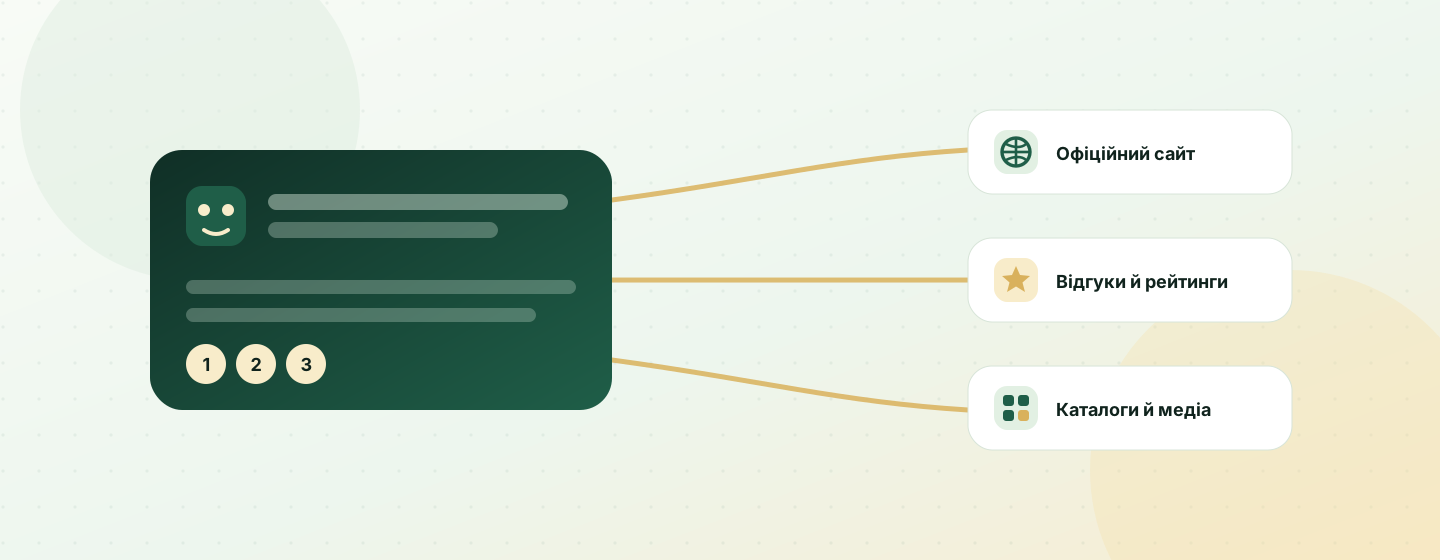
This shows how to track AI citations by URL and distinguish a cited source from a brand mention in the answer. The result applies to the queries, systems, and dates you recorded. It does not describe the whole web or every possible answer.
For a closer look at the kinds of outside sources that may appear alongside citations, see AI trust sources: website, PR, directories, or reviews.
Why ChatGPT cites the wrong page
If ChatGPT cites a different page on your site, compare both URLs against the query's intent. An older blog post may contain a more direct answer than a commercial page, but verify that by reviewing the actual content, not by page type.
- Read the heading and first substantive section on both pages. Does the intended URL answer the same question?
- Look for topic overlap. If both URLs answer the same query, clarify their roles or consolidate the material according to your site's editorial rules.
- Check the canonical URL and internal links. They should help readers and search engines identify the main page for the topic.
- Run the query again and record which URL appears as a source.
If the other URL still answers the query more directly, revise the intended page or change which URL you want to use. AI may cite a different page on your site because it appears to answer that query more directly. One result does not establish a lasting pattern.
How to optimize a page for AI search
Start with the question the page is meant to answer. Then check the following:
- State the answer near the top of the page, with the conditions and limits readers need.
- Use a table to compare criteria and a list to show steps when those formats help readers.
- Keep FAQ questions when readers actually ask them and each has a useful answer.
- Check factual claims and the sources that support them.
- Confirm that the target page is accessible and internal links point to the intended URL.
- After making changes, repeat the check with the same query and record the date and sources. Keep URL citation records together so you can compare sources when you run the query again.
To make a page easier for AI to cite, assess how well it matches the query and whether it is accessible. None of these checks guarantees a citation. Recrawl timing and the source set depend on the system, so the timing cannot be predicted precisely.
What not to do
- Do not repeat a keyword in every paragraph. Write for the reader and keep wording that accurately describes the page.
- Do not create a separate page for every similar query. First check whether the intents differ.
- Do not block a crawler without checking which kind of access the rule restricts.
- Do not infer visibility from one answer. Save the query, mode, date, and URL so you can compare a later check.
Frequently Asked Questions
What pages does ChatGPT cite? Check the source URLs shown for your queries. Page format alone cannot establish which URLs will be cited or how often.
Does ChatGPT cite blog posts? Check blog URLs in your own sample. The format alone does not determine whether a post appears as a source.
How can I check whether ChatGPT cites a specific page? Run a relevant query with web search on and open the sources shown with the answer. Record the exact URL and date.
How to make a page easier for AI to cite? Give a direct answer, explain its conditions, and check that the page is accessible. This is an editorial practice, not a guarantee of inclusion.
What makes a web page citable by AI? Readers need to find a direct answer, support for important claims, and the limits of the advice. These checks improve clarity for people, but do not guarantee that an AI system will cite the page.
Why does ChatGPT cite the wrong page? Compare the intended URL with the one shown as a source. Check which page answers the query more directly, then review topic overlap and internal links.
Why does AI cite a different page on my site? Compare how well each page matches the query. Check for overlapping topics, the canonical URL, and internal links.
How we do it in VYDAI
In VYDAI, the Sources page shows URLs found in collected answers and the systems associated with them. As of October 2026, VYDAI supports ChatGPT, Gemini, Claude, Google AI Overviews, and Google AI Mode. Review the sources for a query to see what pages ChatGPT cites, then compare those recorded URLs with your own pages. Keep tracking citations for each URL with its query and date, then compare them with the next check. VYDAI displays observed sources; it does not predict which pages should appear.
See the VYDAI demo or create an account to view the Sources page.