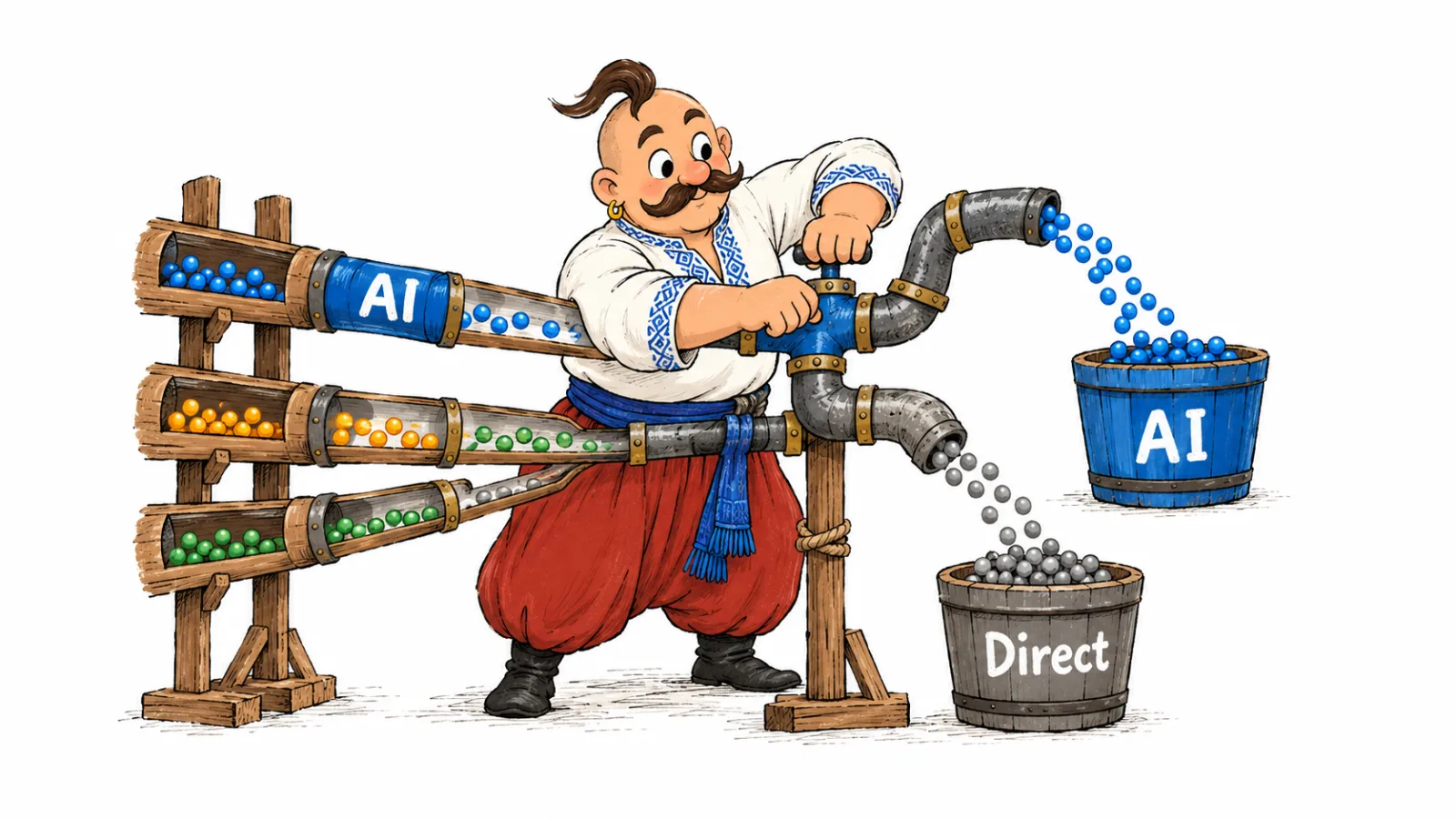
The sources that influence ChatGPT brand recommendations depend on the user's intent and the search mode. A company website explains its offer; reviews describe customer experiences; directories, media, and public discussions add outside context.
Inspect answers to buyer queries and open the pages they cite to see which sources appear in a particular market. This is an observation of visible answers, not a universal ranking formula. Systems and search modes can draw on different sources.
How AI search answers use sources
When web search is available, an answer may draw on web pages and show links to sources. ChatGPT may search automatically, and its Sources panel can include cited pages and other relevant links.
OpenAI warns that search results and citations can be incomplete, outdated, or incorrect. Open each link and check what the page actually supports (OpenAI's guide to searching the web with ChatGPT).
Google says AI Overviews and AI Mode may use query fan-out, issuing several related searches across subtopics and sources. The two features can show different links.
A page must be indexed and eligible to appear with a regular Search snippet. Google does not guarantee that an eligible page will appear and does not require special schema.org markup for AI Overviews or AI Mode (Google's documentation on AI features in Search).
For the distinction between checking citation URLs and deciding which source types to work on, see how to analyze ChatGPT sources and citations. That article explains how to find and record specific pages in answers. This one focuses on source categories and what to improve in a brand's public presence.
Why your own website still matters
A website is a source the company can maintain. It should state what the company offers, where it operates, who its services suit, what they cost, and what limitations apply. Check that purchase and product pages answer customer questions, that key text is available without JavaScript, and that pages can be found in Search. For AI Overviews and AI Mode, Google requires indexing and eligibility for a regular snippet, but says inclusion is not guaranteed.
Use verifiable details. A case study should distinguish the work performed from its result. A review should describe a real experience and identify its author as the platform allows. Structured data should match visible page content. Read more about structured data and AI visibility.
ChatGPT Search also has a separately managed crawler. As of October 2026, OpenAI describes OAI-SearchBot as the crawler for ChatGPT search features and GPTBot as a crawler associated with model training. Their robots.txt controls are independent. Allowing a crawler does not guarantee placement in a search answer (OpenAI's crawler documentation).
Source types to check
The table is a checklist of categories to look for in answers and web search. Use it to plan a review for your market.
| Source type | What to check | Practical action |
|---|---|---|
| Company website | Name, category, services, prices, locations, evidence, and limits | Make company pages match the actual offer |
| Reviews | Platform, author's experience, context, and date | Ask for honest feedback after a real interaction; do not reward a rating |
| Business directories and rankings | Category, profile accuracy, description, and roundup pages | Correct inaccurate listings and update facts |
| PR and media | Authorship, editorial context, and support for claims | Offer an expert comment or verifiable data |
| Forums and public discussions | Recurring questions, comparisons, and objections | Answer the question and follow community rules |
| Social and professional profiles | Company name, category, and official website | Update public profiles your audience actually uses |
| Video and marketplaces | Page owner, product identity, attributes, and date | Check names, specifications, and terms against the original source |
| Wikipedia and Wikidata | Independent coverage and entity accuracy | Do not create a promotional page; follow the relevant language edition's rules |
| Documentation and help pages | Instructions, product limits, and current terms | Update documentation when the product changes |

The useful sources depend on the query. Product questions call for product pages and documentation. Questions about customer experience may surface reviews or discussions. A buyer comparing agencies may also encounter industry directories and roundups. A domain appearing in citations does not, by itself, show that a system trusts or recommends the brand.
How Wikipedia affects AI brand visibility
Wikipedia is an encyclopedia, not an advertising directory. A separate article requires independent coverage in reliable sources and must meet the rules of the relevant language edition. For example, English Wikipedia's company guideline describes notability through significant coverage in independent reliable sources (English Wikipedia's notability guideline for organizations and companies).
A page's existence does not establish an effect on AI recommendations.
A citation alone cannot establish how Wikipedia affects AI brand visibility. Open the specific page and check which claim it supports. If a company lacks independent coverage, improve the quality of public material and the accuracy of its profiles before considering whether an encyclopedia article is appropriate.
Does PR affect AI search visibility
PR can give readers outside context when a publication has an author, explains the company's role, and supports its claims. A mention alone does not prove trust or an effect on AI recommendations. Check whether the article is relevant to the category, names the brand correctly, and is still accurate.
For an expert comment, offer a checkable fact, explain its limits, and link to the original source. Repeating the same press release across sites does not replace editorial coverage. Record which media pages appear in your answer sample and assess whether they relate to buyer queries.
How Reddit affects ChatGPT recommendations
Reddit and other forums can contain first-hand experiences, comparisons, and objections. Does ChatGPT use Reddit for brand recommendations? Do not infer that from one answer or a partnership announcement. OpenAI has announced access to Reddit's Data API for ChatGPT. Google has announced access to the Reddit Data API and that Reddit uses Vertex AI in its own features. These announcements confirm partnerships and access to content; they do not prove that every answer or recommendation uses Reddit (OpenAI's Reddit partnership announcement, Google's Reddit partnership announcement).
Participate as a member of the community, not as a disguised advertiser. Follow each forum's rules, answer the question, and disclose your connection to the company when required. Recurring questions can help you improve your own product documentation and comparison pages.
Do reviews influence AI brand recommendations
Do reviews influence AI brand recommendations? Check answers to commercial queries in your category. OpenAI's help page describes summaries of public reviews in ChatGPT Shopping product results. It does not establish the general weight of reviews in recommendations for services or companies (OpenAI's help page on Shopping in ChatGPT Search). For a closer look at product recommendations, see how ChatGPT Shopping selects ecommerce products.
A useful review tells a reader which product or service was assessed and what the experience was. Do not buy reviews or ask customers to repeat target keywords. Google's review snippet rules exclude a company's own page from star review features when it contains reviews about that company, including reviews embedded through a third-party widget. As of October 2026, this remains in Google's documentation on self-serving reviews (Google's review snippet guidelines). That rule concerns how reviews appear in Search; it does not set their weight in AI recommendations.
How do business directories affect AI recommendations?
Check the business directories that actually appear in your category to see how they affect AI recommendations. Verify the name, category, location, link, service description, and update date. An agency may need an industry directory; a local company may need an accurate map listing; software buyers may consult product directories with reviews and comparisons. Do not create a profile on every available site if buyers do not use it.
For B2B and IT services, check Clutch and GoodFirms; for software, check G2 and Capterra. In TrustRadius's 2025 survey, 77% of 2,058 technology buyers said they read user reviews during a software purchase. The source map for B2B and IT vendors compares these directories with other sources and buyer questions.
| Business type | What to check first | What to verify |
|---|---|---|
| Local service | Map listing and service pages with locations | Address, hours, and service area agree |
| B2B SaaS | Product pages, review profiles, and comparisons | Use cases and limitations are clear |
| Agency | Industry directories, service pages, and case studies | Cases support the stated specialization |
| Online store | Product listings, marketplaces, and public reviews | Specifications, price, and availability match |
| Expert or consultant | Profile, authored material, and independent mentions | Experience, subject area, and authorship are clear |
| Startup | Website, product profile, and industry mentions | Name, category, and product description are current |
How can a brand keep its information consistent across sources?
Start with a short list of verified facts: official name, category, audience, geography, main services, and website. Compare that list with your site, profiles, reviews, and pages that actually appear in answers. When descriptions differ, find out whether one is inaccurate or reflects a source author's valid perspective.
Hypothetical example: a website positions a service for large teams, while a directory lists it as a tool for small teams. Check the product and the directory profile, then correct the profile if it is inaccurate. Do not paste identical promotional copy across platforms. The goal is for different authors to describe the same factual offer.
How can I check the sources behind AI brand recommendations?
Gather real buyer queries, record the system, mode, and date, then save the answers and source URLs. Separate a domain appearing in citations from a brand mention in the answer. ChatGPT's Sources panel can also show relevant links beyond its citations, so open each page and check what claim it supports.
Classify each page as a company site, review, directory, media article, discussion, profile, video, or another source type. Compare answers from the same queries and modes. Call a one-off check an example, not a trend. The source-analysis guide covers recording specific citations.
Start with a source that appears in your answers and contains an error or a material gap. The sources that influence ChatGPT brand recommendations in your market are the ones you can verify in repeated answers. If competitors dominate the answers, use the method for analyzing AI recommendations of competitors as well.
What not to do
Do not assume that a particular directory or a specific number of reviews will secure a recommendation. Do not post promotional discussions while pretending to be a customer. Do not copy someone else's rating into your own markup as if it were your rating. Do not treat a domain citation as proof that the answer mentioned your brand.
Check the original page and its date before changing your own site.
Frequently Asked Questions
Do reviews influence AI brand recommendations? Reviews may appear among the sources a system shows or summarizes for a particular task. Check answers in your category and do not treat ChatGPT Shopping product summaries as a general rule for every brand.
Does ChatGPT use Reddit for brand recommendations? Check whether Reddit pages appear for your queries and what they say about the brand. A platform partnership alone does not prove that Reddit affected a particular recommendation.
Does Google require special schema for AI Overviews? No. Google says no special schema.org markup is needed for AI Overviews or AI Mode. Make sure existing markup matches the page's visible content.
How can I check the sources behind AI brand recommendations? Save answers to the same queries, record the system, mode, date, and cited URLs, then open each source. Record separately whether the answer mentions your brand.
How can third-party brand mentions affect AI search? Understanding how third-party brand mentions affect AI search starts with opening the page and checking whether it names the brand accurately and supports the claim in the answer.
How does Wikipedia affect AI brand visibility? The existence of a page does not prove an effect. Check whether a mention follows Wikipedia's rules and whether independent sources support the facts you need.
How we do it in VYDAI
In VYDAI's Sources section, you can filter sources by system, type, and period, then inspect domains, individual pages, citation counts, and sample answers that mention your brand. As of October 2026, VYDAI checks ChatGPT, Gemini, Claude, Google AI Overviews, and Google AI Mode. Perplexity is not one of its monitored systems.
A spreadsheet with answers and URLs is enough for an occasional check. This lets you review the sources that influence ChatGPT brand recommendations in your own answer sample. To compare sources across systems and periods regularly, you can view the VYDAI demo or create an account.