Practice
Practice and Methodology
How to choose prompts, read sources, find competitive gaps, and turn monitoring into SEO, content, and PR actions.
Category articles
18 articles in this section
These pieces help you move from general understanding to concrete monitoring, content, SEO, and PR decisions.
Who this helps
Teams that are ready to test prompts, read sources, compare competitors, and turn findings into a plan.
All articles in this section
Each article answers a specific question: what to check, how to interpret an AI answer, and what to improve next.
GEO for B2B and IT companies: how AI helps buyers choose a vendor
GEO for B2B means making sure that when a buyer asks AI to compare vendors, your company is described with accurate facts and evidence. GEO for IT companies starts with clear information…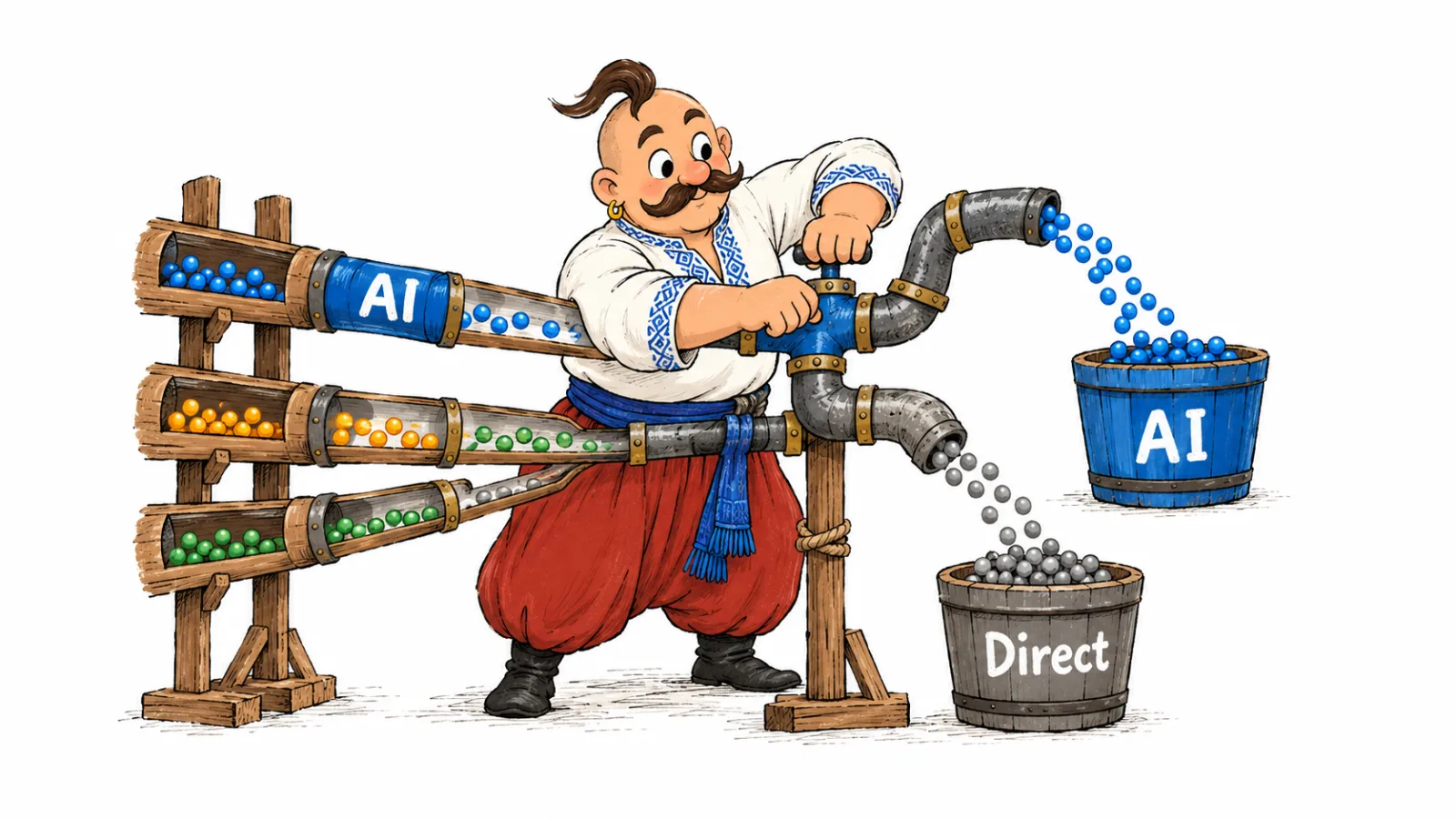
How to track ChatGPT, Gemini, and Perplexity traffic in GA4
To track ChatGPT traffic in GA4, start with the AI Assistant channel in Traffic acquisition (Reports → Acquisition → Traffic acquisition). Google added it to the default channel group on…
AI search readiness: a practical audit checklist
A GEO audit checks whether search systems can retrieve important URLs, whether a page answers customer questions clearly, and whether its key claims can be verified. Each finding should…
How to appear in Google AI Overviews and AI Mode
To appear in Google AI Overviews or AI Mode, a page must be indexed and eligible to appear with a snippet in Google Search. Check that your site is also included in Search generative AI…
How to check AI crawler access to a website
Here is how to check AI crawler access to a website: compare the page's robots.txt rule, HTTP response, returned HTML and protection settings. It may open in Chrome while a test request…
How to read a GEO audit report and prioritize fixes
To read a GEO (generative engine optimization) audit report, start with the URL, run date and evidence behind each finding. VYDAI's overall score summarizes page-readiness checks under the…
AI crawlers in robots.txt: GPTBot, ClaudeBot, and more
AI crawlers in robots.txt need separate rules by purpose. A search crawler can help a page appear in search answers, while a training crawler may collect public material for model…
ChatGPT Shopping: how to list store products on ChatGPT
To list store products on ChatGPT, check whether your catalog is on Shopify or Etsy, or apply to OpenAI to provide a direct product feed. Make product pages accessible to search and keep…
How to fix wrong information about your business in ChatGPT
To fix wrong information about your business in ChatGPT, save the exact answer and check where the false claim may have come from. Correct the page or profile that contains it, then repeat…
What sources influence ChatGPT brand recommendations?
The sources that influence ChatGPT brand recommendations depend on the user's intent and the search mode. A company website explains its offer; reviews describe customer experiences;…
How to create llms.txt: format, example, and checks
To create llms.txt, add your site name, a short factual summary, and links to useful public pages. It is a proposed Markdown format, a way to structure plain text, not a Google requirement:…
Structured data for AI: how schema affects visibility
Structured data for AI connects page facts to entities and properties: a price to a product, business hours to a location, and an author to an article. A practical start is to describe the…
How to check ChatGPT sources and analyze AI citations
To check ChatGPT sources, save the links shown with a specific answer and record the query, mode, and date. Then check what each page supports and compare domains across queries. This…
How to choose prompts for AI visibility tracking
To choose prompts for AI visibility tracking, start with the situations in which customers select a product: by budget, use case, brand comparison, or reliability. Separate branded and…
How to turn an AI visibility report into an action plan
To turn an AI visibility report into an action plan, connect each finding to a specific answer, cited source, or prompt, classify the gap, and assign an owner and a way to check the work.…
What pages does ChatGPT cite? A page-checking guide
What pages does ChatGPT cite? The DeltaV Digital study found articles, listicles, and product pages among cited sources, while Far & Wide's research described differences across content…
Why ChatGPT recommends competitors and how to check
ChatGPT recommends a competitor when that company’s pages and available sources better match the prompt, or when the prompt describes a need your business does not meet. To find the…What to read next
These adjacent articles help you move from theory to practice or view the topic through a different market angle.
ChatGPT vs Gemini vs Claude vs Perplexity: how AI chooses brands
How AI chooses brands in practice comes down to three differences you can check: which search index or providers a web-enabled answer uses, whether it displays sources, and whether its…
AI search vs Google search: how the buyer journey changes
AI search vs Google search can describe different formats within one buyer journey. In an AI answer, a buyer may compare options, build a shortlist, and see cited sources before visiting a…
How to measure AI visibility: metrics alongside SEO
To measure AI visibility, use the same real-world prompt set and mark whether each answer mentions the brand, links to its site, or recommends it. Calculate mention share, citation share,…Other blog topics
Switch between foundations, practical methodology, and market research when you need a different angle.
5 articles
AI Visibility Foundations
Plain-language guides on how AI changes search, why brands disappear from answers, and which signals influence visibility.
Open category 1 articleMarket Research
Applied breakdowns of niches, brands, and sources that ChatGPT, Gemini, and Claude rely on in specific verticals.
Open category