Kyivstar, Ukraine's largest mobile operator, appears in 99.0% of answers about mobile operators and is listed first in 93.3%. lifecell appears in 91.2% of answers, but it came first only twice out of 1,350. At the other end, in nine of 49 categories, no brand appears in even 20% of answers. AI brand visibility varies by industry: in some categories the first line is nearly taken, while in others mentions are spread across many names.
This study covers 50 Ukrainian prompts in each category, nine waves from June 14 to October 6, 2026, and 65,544 successful answers. We tested the API models Claude Haiku 4.5, Gemini 3.1 Flash-Lite, and GPT-5 nano without web search. The practical distinction is clear: in a concentrated category, the fight is for the first line of the list; in an open one, it is for being named at all.
How we counted mentions and first place
Each of the 49 categories had 50 Ukrainian prompts. The models were asked to name 7 to 12 companies. Runs took place about every two weeks. The main window covers waves 3 through 11, or nine waves. Most categories have 1,350 successful answers, with 450 from each model.
| Metric | What we count | How to read it |
|---|---|---|
| Brand coverage | Share of category answers that mention a brand at least once | “Kyivstar appeared in 99.0% of answers” |
| First position share | Share of all category answers in which the brand is first in the extracted list | “Kyivstar was first in 93.3% of answers” |
| First when mentioned | Answers with the brand in first place divided by all answers that mention it | Shows how often a mentioned brand also opens the list |
| Brands with at least 20% coverage | Number of brands named in at least one fifth of category answers | Separates a long tail of names from a shorter set of visible players |
Position means the order in the extracted list. It is not a verdict on quality or a label for the “best” company. That is why every table below keeps coverage and first position apart: a brand can be in almost every list and almost never first, like lifecell.
Which brands does AI recommend most often across 49 categories?
The median coverage of a category leader is 49.1%. In four categories the leader appears in at least 90% of answers; in 23 it appears in at least half. In nine categories the leader does not reach 20%. Mention frequency alone does not determine which brand comes first.
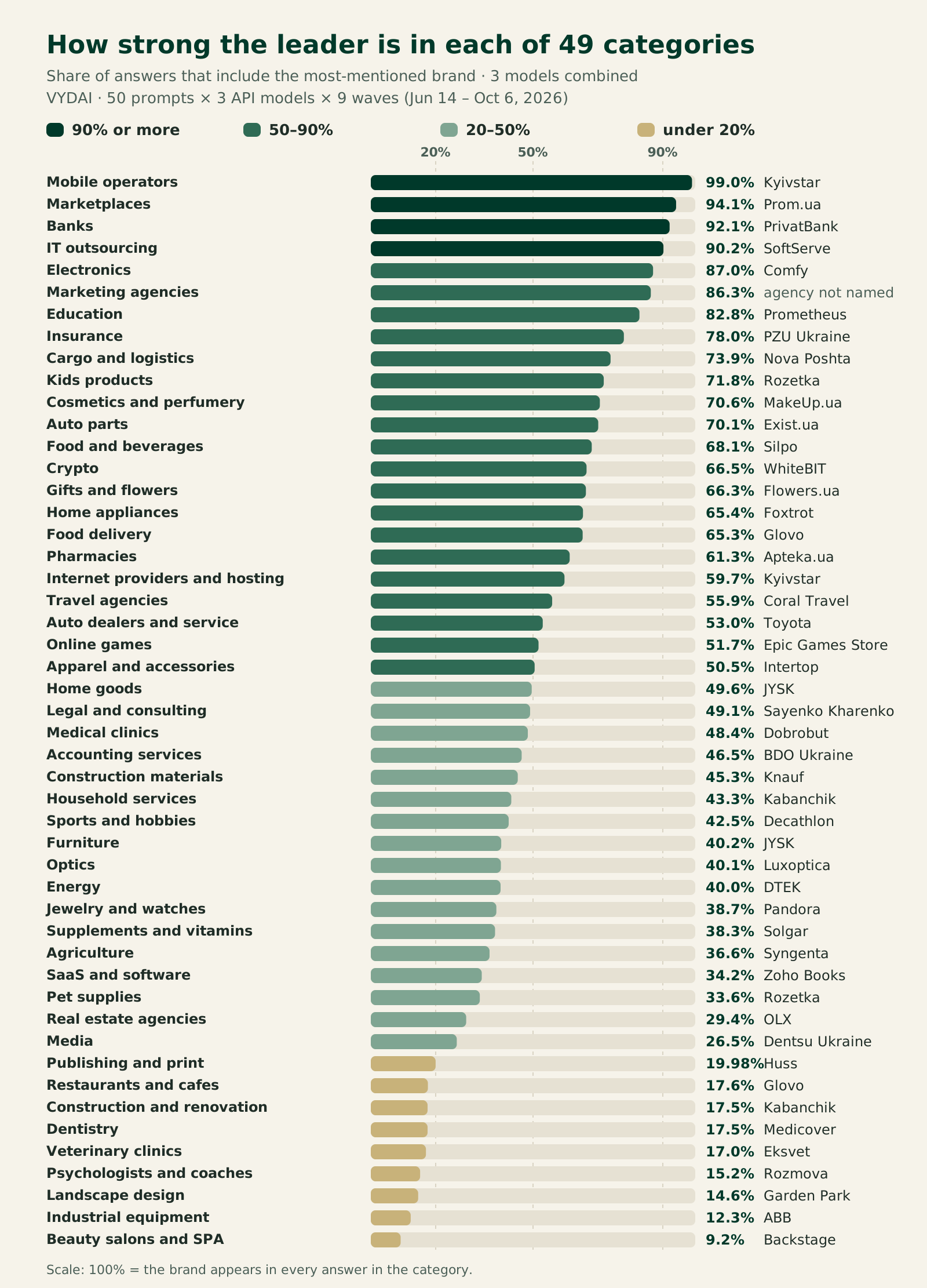
| End of spectrum | Category | Most mentioned brand | Coverage | Brand most often listed first |
|---|---|---|---|---|
| Highest | Mobile operators | Kyivstar | 99.0% | Kyivstar, 93.3% |
| Marketplaces | Prom.ua | 94.1% | Rozetka (Ukrainian marketplace), 41.7% | |
| Banks | PrivatBank (Ukrainian bank) | 92.1% | PrivatBank, 60.1% | |
| IT outsourcing | SoftServe | 90.2% | SoftServe, 36.6% | |
| Electronics | Comfy | 87.0% | Rozetka, 48.5% | |
| Lowest | Publishing and print | Huss | 19.98% (262 of 1,311) | Huss, 13.0% |
| Restaurants and cafes | Glovo | 17.6% | McDonald's Ukraine, 10.6% | |
| Construction and renovation | Kabanchik | 17.5% | YouDo, 6.3% | |
| Dentistry | Medicover Ukraine | 17.5% | Medicover Ukraine, 14.4% | |
| Veterinary clinics | Eksvet | 17.0% | Alden-Vet, 10.7% | |
| Psychologists and coaches | Rozmova | 15.2% | BetterHelp, 5.5% | |
| Garden and landscape design | Garden Park | 14.6% | Landshaft Studio, 4.1% | |
| Industrial equipment | ABB | 12.3% | DMG MORI, 8.2% | |
| Beauty salons and spas | Backstage | 9.2% | Backstage, 6.5% |
These examples show two different kinds of lead. In mobile service, one brand dominates both coverage and first place. In electronics, Comfy is mentioned more often, while Rozetka opens the list in almost half of category answers. In online games, Epic Games Store appears in 51.7%, but Steam is first in 39.2%. “Which brand appears most often?” and “which one does the reader see first?” need separate numbers.
Some frequent names are platforms or aggregators rather than specialist companies in the category. Glovo appears in restaurant answers, Kabanchik in construction, and OLX.ua in real estate. Before comparing a business with the apparent leader, check how the category is framed and what kinds of companies enter the list.
Which mobile operators does AI recommend in Ukraine?
Kyivstar appears in 1,336 of 1,350 answers and is listed first in 1,260. Vodafone Ukraine appears in 1,241 answers but comes first in 40. lifecell appears in 1,231 answers, with a first position share of 0.15%, or two answers.
| Model | Kyivstar: mentioned / first | Vodafone Ukraine: mentioned / first | lifecell: mentioned / first |
|---|---|---|---|
| Claude Haiku 4.5 | 98.9% / 88.2% | 99.3% / 7.8% | 94.2% / 0.4% |
| Gemini 3.1 Flash-Lite | 99.8% / 95.3% | 88.0% / 0.4% | 84.0% / 0% |
| GPT-5 nano | 98.2% / 96.4% | 88.4% / 0.7% | 95.3% / 0% |
| All models | 99.0% / 93.3% | 91.9% / 3.0% | 91.2% / 0.15% |
Coverage barely separates the three operators: all appear in most lists. First position separates them sharply. Kyivstar was first in 88.0% to 95.3% of answers in each of 11 waves since May. Vodafone and lifecell remain visible, but their second and third places rarely become first.
The subscriber bases put that difference in context. VEON's 2025 annual report lists National Commission data as of September 30, 2025: 22.5 million Kyivstar customers, 15.4 million Vodafone Ukraine customers, and 9.8 million lifecell customers. Together that is 47.7 million. The shares below are calculated from those three bases, not from a count of unique people.
| Operator | Customer base, millions, as of Sep 30, 2025 | Share of the three bases | First position in AI answers |
|---|---|---|---|
| Kyivstar | 22.5 | 47.2% | 93.3% |
| Vodafone Ukraine | 15.4 | 32.3% | 3.0% |
| lifecell | 9.8 | 20.5% | 0.15% |
Kyivstar's share of first positions is roughly twice its share of the combined customer base of these three operators. This compares different measures, not market share: customer bases are not unique people, and text position is not sales or trust.
What does first position in an AI answer mean?
In the mobile operator answers we read, lists had headings such as “Main operators” or “Market players.” Kyivstar was described as the largest operator by subscriber count. GPT-5 nano often returned a bare list. Kyivstar also appeared first for a prompt asking which operators to check for complaints and hidden fees.
Context snippets across all 49 categories support that reading. Among snippets for the first brand, words such as “largest” appear in 23.5% of Claude snippets and 27.1% of Gemini snippets. Terms such as “best” or “No. 1” appear in less than 1% for both. GPT-5 nano rarely adds superlatives because it often returns a list without explanation.
| Model | First brand snippets containing “largest…” | “leader/leading” | “best/No. 1” | Any of these superlatives |
|---|---|---|---|---|
| Claude Haiku 4.5 | 23.5% | 5.1% | 0.7% | 28.5% |
| Gemini 3.1 Flash-Lite | 27.1% | 11.7% | 0.9% | 39.1% |
| GPT-5 nano | 0.5% | 0.7% | 3.5% | 5.3% |
An external example makes the difference between presence and order concrete. In SparkToro's January 2026 study, City of Hope appeared in 69 of 71 ChatGPT answers to a prompt about cancer hospitals on the US West Coast, but was first in 25. Presence and order diverged there too.
In this sample, first place went to the player the model treated as the main or largest in the market, not the winner of a comparison against the criteria in the prompt. The snippets were about 200 characters long and could include the list heading, so counts for words such as “best” are an upper bound.
Category leaders in AI answers: leaders, runners-up, and niche firsts
The aggregate comparison covers 162 brand and category pairs where a brand appeared in at least 30% of its category's answers. It separates coverage from first place. In 54 pairs, a brand was first in less than 5% of answers that mentioned it. In 22 pairs, the brand was first in at least half of the answers that mentioned it.
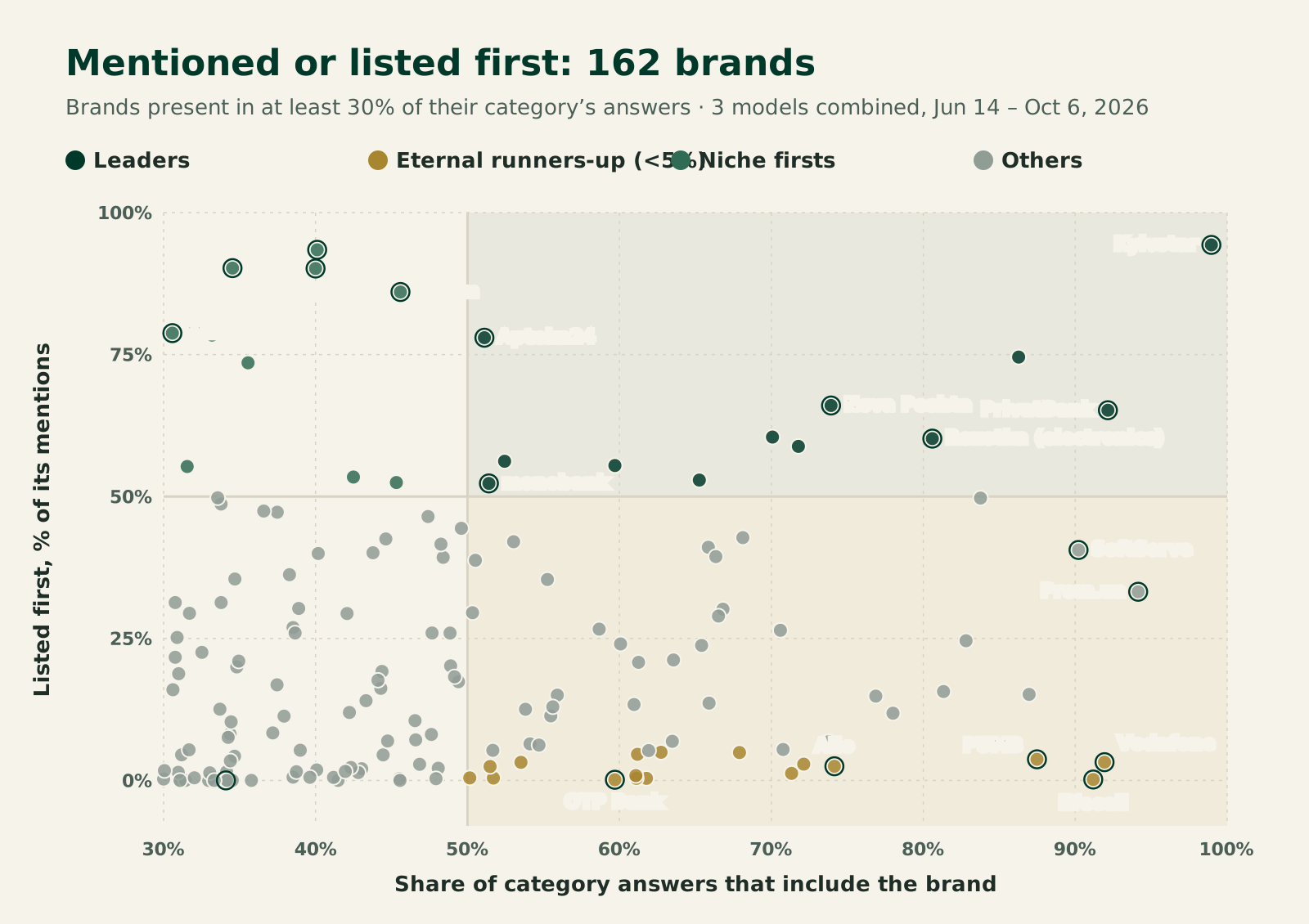
| Position type | Examples: coverage / first place among mentions | What to check |
|---|---|---|
| Leaders with broad presence | Kyivstar 99% / 94%; PrivatBank 92% / 65%; Nova Poshta (Ukrainian delivery company) 74% / 66% | The brand appears often and usually opens the list |
| Eternal runners-up | lifecell 91% / 0.2%; Vodafone Ukraine 92% / 3.2%; PUMB 87% / 3.7%; OTP Bank 60% / 0.1% | Presence is high, but a competitor almost always gets the first line |
| Niche firsts | Luxoptica 40% / 93%; ARX 35% / 90%; DTEK 40% / 90%; Steam 46% / 86% | The brand reaches fewer answers, but often leads when it appears |
| Present, rarely first | GlobalLogic 34% / 0%; Credit Agricole 36% / 0%; Shafa.ua 31% / 0% | Separate list visibility from competitiveness for the first position |
In banking, PrivatBank, a Ukrainian bank, has 92.1% coverage and is first in 60.1% of all answers. PUMB has 87.5% coverage but only 3.3% first positions. OTP Bank appears in 59.7% and came first once out of 1,350 answers. Monobank has 51.4% coverage and is first in 26.9% of all answers. Gemini lists Monobank first in 63.1% of its answers.
“Eternal runner-up” describes an aggregate pattern, not a prediction for every prompt. Checks by model found PUMB and OTP Bank rarely first across all three models. In IT outsourcing, GlobalLogic was never first in any model. DataArt came first in 1.6% of Claude answers, and in none from Gemini or GPT-5 nano. Use the quadrant as a starting point for diagnosis, since a brand's result can depend on the model or prompt intent.
Why one brand dominates AI answers
In the examples we read, the first brand was often described as the largest. Kyivstar's share of first positions is also much higher than its share of the three operators' combined customer base. This is a correlation in these results, not proof of what causes a model to choose a brand.
An arXiv preprint by Dmitrij Żatuchin, revised in September 2026, tested 50 brands across five industries. It used 250 queries, each run five times on GPT-5.2, Gemini 3 Flash, and Perplexity sonar-pro. About 7.6% of queries had no sampled brand in the answers. Recommendation shares from February and September had a Spearman correlation of 0.994. The author describes the work as exploratory, and brand matching validation as provisional. Our waves show the same thing over a shorter period: Kyivstar opened the list in 88.0% to 95.3% of answers in each of 11 waves. So judge the effect of any change over several measurements, not over a week.
The practical next step is to measure not only brand visibility but also where it appears, for which prompts, and in which model. To assess which public sources describe a company as the main or largest player, read our guide to AI trust sources: websites, PR, directories, or reviews.
Leader strength differs by model
The median coverage of a category leader is 40.7% for Claude Haiku 4.5, 69.1% for Gemini 3.1 Flash-Lite, and 74.4% for GPT-5 nano. Claude has 12 categories where no brand reaches 20% coverage; Gemini has none, and GPT-5 nano has four. A brand comes first in at least half of answers in 6 Claude categories, 13 Gemini categories, and 14 GPT-5 nano categories.
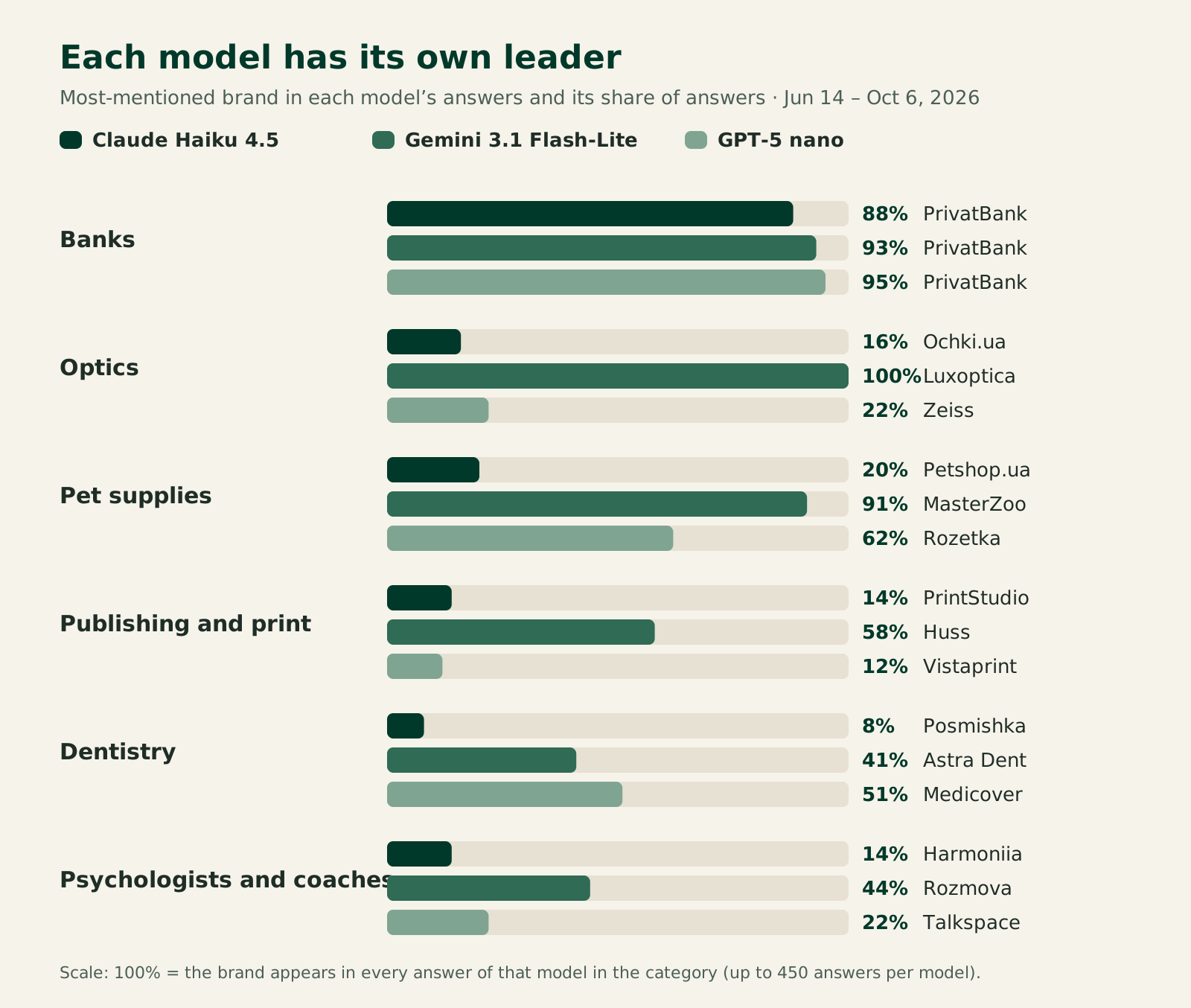
Optics illustrates the difference. Gemini lists Luxoptica in 100% of optics answers and first in 100%. Claude mentions it in 15% of answers, and GPT-5 nano in 1%; GPT's own category leader is Zeiss, with 22% coverage. In pet supplies, Gemini's MasterZoo has 91% coverage, Claude's Petshop.ua 20%, and GPT-5 nano's Rozetka 62%. The dentistry leaders are Posmishka, Astra Dent, and Medicover Ukraine.
Treat each model's report as a view of that system. If customers use several, track a separate view for each before drawing a category-wide conclusion. How much the brand lists of different models overlap at all is the subject of our separate study: do AI models recommend the same brands.
Open categories: can a small business appear in AI recommendations?
In nine categories no brand appears in even 20% of answers: publishing and print, restaurants and cafes, construction and renovation, dentistry, veterinary clinics, psychologists and coaches, garden and landscape design, industrial equipment, and beauty salons and spas. Answers still name companies. Those names are spread across a longer list, so even the most frequent one appears less often.
An open category can give a small business more room because no single name appears almost every time. That does not make visibility automatic. Check whether the model recognizes the brand, names relevant competitors, and returns it across useful prompts and models. In local categories the models often disagree even on the leader: for psychologists and coaches, Claude most often names Harmoniia (14% of its answers), Gemini Rozmova (44%), and GPT-5 nano Talkspace (22%). A place in one model does not guarantee a place in another.
In beauty salons, the aggregate leader Backstage has 9.2% coverage. Claude's leader, Beauty Lab, appears in 12% of its answers. GPT-5 nano most often returned the text label “manicure/pedicure,” which is extraction noise rather than a brand. Our related study of AI-generated company websites also distinguishes a real company mention from an erroneous string in an answer.
Yes, a small business can appear in AI recommendations, especially where there is no strongly visible category leader. Use a practical test: the brand should recur across several relevant prompts and remain present across models. One answer is not evidence of sustained visibility; our study of why AI gives different answers shows why.
What a brand should do in each category
Start with two measures: how often the brand appears and how often it comes first. Then use the pattern to choose what to investigate.
| Situation | Measure next | First action |
|---|---|---|
| Concentrated category, your brand leads | Coverage and first position by model | Check whether the lead holds across different intents, not just a broad prompt |
| Your brand is mentioned often but rarely first | First place among your mentions and the competitors listed ahead of it | Identify the contexts where it follows a leader, then use our method for understanding why AI recommends competitors |
| Your brand leads a niche | Coverage beyond a narrow prompt set and differences by model | Check whether first place depends on one prompt type |
| No strong leader in the category | Number and accuracy of names, plus whether your brand appears | Expand the prompt set around real customer needs using our guide to choosing prompts for AI visibility monitoring |
| Your brand is absent | Prompts that should name it and spelling variants | Check for the brand across different phrasings before changing content |
Don't set "be first" as a goal without context. AI brand visibility varies by industry: in mobile operators the first line is highly concentrated, in beauty salons it is spread out. In one category it pays to grow mention frequency; in another it matters more to find out why you are skipped. And don't substitute these metrics for market share: the data sources and denominators differ.
Research limitations
We queried API models without web search. That is not the same environment as consumer Claude, Gemini, or ChatGPT applications. Versions, system instructions, personalization, and internet access may differ. These findings apply to the described setup and period only. The model IDs match the developers' documentation: Claude Haiku 4.5, Gemini 3.1 Flash-Lite, and GPT-5 nano.
Each model was asked to name 7 to 12 companies. A separate structured extraction process based on GPT-5 nano identified brands and their list order. Position 1 means the first name in that extracted list; the model did not judge company quality. Some duplicates were not merged, and a few answers included irrelevant names or text labels. Categories with fewer than 1,350 answers had GPT-5 nano validation failures. Veterinary clinics, for example, had 1,256 successful answers.
The aggregate across three models can hide different local patterns, so the article also reports model-level figures. Mobile customer base data are from September 30, 2025, in a VEON table that cites Ukraine's regulator. They are not current subscriber totals. The shares are calculated from the three bases and do not count unique people.
SparkToro's study used US volunteers and consumer AI tools, while this research used fixed Ukrainian prompts and APIs without web search. The arXiv preprint covers five industries and has provisional brand matching validation. Neither study establishes why a particular brand dominates a Ukrainian category.
Frequently asked questions
Which brand does AI list first in Ukraine?
It depends on category and model. For mobile operators, Kyivstar was first in 93.3% of answers. The leading brand and its first position share differ elsewhere.
What does first position in an AI answer mean?
It is the first brand in the extracted list. This study does not treat it as a judgment that the company has the best quality or price.
Can a small business appear in AI recommendations?
Yes. In nine categories, no brand reached 20% coverage. Check repeated, relevant prompts rather than relying on one answer.
Are category leaders the same across AI models?
Not always. In banking all three models shared a leader, but in optics, pet supplies, and dentistry the most mentioned brands differed.
How often should I check AI recommendations?
Checking every two weeks makes it possible to compare a new measurement with the previous one at the cadence of our panel. That is not a universal rule. Use the same prompts over several measurements before drawing a conclusion.
Is AI mention share the same as market share?
No. Mention share uses answers to prompts as its denominator. Market measures use data such as customer bases or assets.
How we do it in VYDAI
For your own brand, VYDAI tracks mentions in ChatGPT, Gemini, Claude, Google AI Overviews, and AI Mode. In the app, add competitors and compare their visibility and prompt coverage by AI system. This shows whether the issue is a missing mention, narrow coverage, or being named after a competitor. You can open the VYDAI demo or register to try it with your brand.