Top-10 brand lists from two different models in the same niche overlapped by only 2.9–4.3 positions out of 10 on average. Do AI models recommend the same brands? Only partly: in 9 of 49 categories, no brand appeared in all three top-10s. We compared Claude Haiku 4.5, Gemini 3.1 Flash-Lite, and GPT-5 nano through their APIs with web search off. These are not the consumer Claude, Gemini, or ChatGPT apps. For brevity, we call them Claude, Gemini, and GPT below. The dataset covers 50 identical Ukrainian prompts per niche and nine waves from June 14 to October 6, 2026: 65,544 answers in total. One model's report describes that model's own market, so how many models you need depends on the niche: lists diverge most in local services.
How we compared the three models
This study measures overlap in AI brand recommendations using the same prompt set for three API models. OpenAI was represented by GPT-5 nano, not the model that answers users in the ChatGPT app.
| Measure | Method |
|---|---|
| Scope | 49 public categories, 50 Ukrainian prompts in each, three models |
| Collection period | Waves 3–11, nine runs from June 14 to October 6, 2026 |
| Answers | 65,544 successful answers out of 66,150 requested |
| Brand coverage | Share of a model's successful answers in a category that mentioned the brand |
| Top-10 | The ten brands with the highest coverage for each model |
| Pair overlap | Number of brands shared by two top-10 lists, from 0 to 10 |
| Jaccard | Shared brands divided by all distinct brands in the two lists combined |
We merged obvious spelling variants before comparing lists, such as KFC Ukraine and KFC. Normalization raised the mean pair overlap by about 0.1 brand and reduced the number of categories with no brand shared by all three models from 10 to 9. Some variants may have remained unmatched, so the measured overlap could be slightly lower than the true overlap.
Here, a recommendation means that a response named a brand. We did not classify each mention as a positive endorsement. We also did not use VYDAI's public rating score, which factors in where a brand appears in the answer; this study counts the share of answers that mention it.
How much do ChatGPT and Gemini brand recommendations overlap?
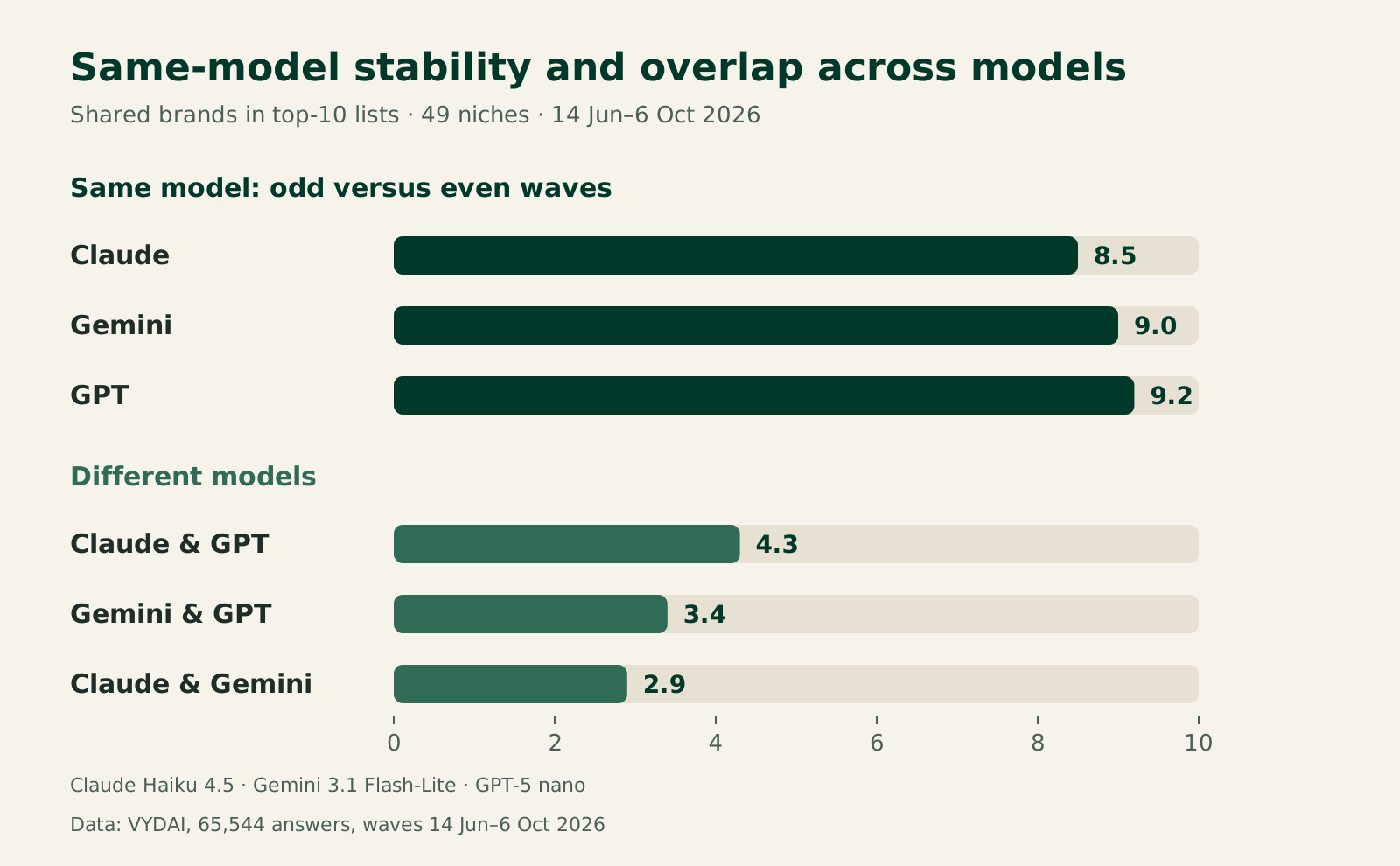
In our test, the OpenAI and Google models (GPT-5 nano and Gemini 3.1 Flash-Lite) shared 3.4 of 10 brands on average.
| Model pair | Mean top-10 overlap, brands out of 10 | Jaccard | Niche range | Niches with zero overlap | Median overlap |
|---|---|---|---|---|---|
| Claude and GPT | 4.3 | 0.30 | 0–8 | 2 | 4 |
| Gemini and GPT | 3.4 | 0.23 | 0–10 | 4 | 3 |
| Claude and Gemini | 2.9 | 0.19 | 0–8 | 5 | 3 |
Claude and GPT agreed most often, while Claude and Gemini agreed least often. Even the highest mean was below half of a top-10 list. The range ran from no shared brands in some niches to a full 10 of 10 for Gemini and GPT in IT outsourcing.
Across 49 niches, the three top-10s contained 1,470 slots and 1,065 distinct brands. 23.8% of slots went to brands included by two models, and another 23.5% to 115 brands that made all three top-10s. The mean number of brands shared by all three lists was 2.35 per category. Nine categories had no such brand.
How often do AI models recommend the same brands? Just over half of all top-10 slots, 52.7%, went to brands included by only one model. That does not mean the other systems never mentioned those brands below the top 10 or in other answers.
Is it just noise? Each model sticks to its own list
We split the nine collection waves into odd and even groups, then built a top-10 for each half. A model's lists overlapped with themselves by 8.53 brands for Claude, 9.04 for Gemini, and 9.20 for GPT, out of 10. Brand recommendation consistency across AI models was far lower: different models over the same halves of the period shared 2.90 to 4.24 brands on average.
Even in the nine niches where no brand appeared in all three top-10s, each model's lists from the two halves still shared 7.44–8.56 brands. In this dataset, differences between models were larger than movement in each model's own aggregated list across waves. A single answer, unlike an aggregated top-10, changes much more; our study of why AI gives different answers to the same prompt measures that and estimates how many prompts you need.
This result can be read alongside SparkToro's study of repeated brand recommendations. It used 12 prompts, 600 volunteers, and 2,961 runs through ChatGPT, Claude, and Google AI. SparkToro reported less than a 1-in-100 chance of getting the same complete list twice for ChatGPT and Google AI. The findings do not conflict: SparkToro compared individual answers to a small prompt set, while we aggregated mentions into top-10 lists across many answers and waves.
Different training data and knowledge cutoffs may contribute to differences between models. Anthropic lists February 2025 as the reliable knowledge cutoff for Claude Haiku 4.5; Google lists January 2025 for Gemini 3; OpenAI lists May 31, 2024 for GPT-5 nano. Our study did not test whether these dates caused the differences. Search-enabled systems can also use different indexes and citations, which is covered in our guide to how AI chooses brands. Web search was off in our runs.
Where models agree: IT outsourcing, electronics, and banks
The strongest agreement appeared where several well-known brands were named often across answers. In IT outsourcing, eight companies appeared in all three top-10s. Gemini and GPT had identical lists.
| Category | Claude and Gemini | Claude and GPT | Gemini and GPT | All three |
|---|---|---|---|---|
| IT outsourcing | 8 | 8 | 10 | 8 |
| Electronics | 6 | 6 | 7 | 6 |
| Mobile operators | 6 | 6 | 8 | 5 |
| Home appliances | 5 | 7 | 8 | 5 |
| Food and beverages | 6 | 6 | 6 | 5 |
| Home goods | 5 | 7 | 5 | 5 |
| Travel agencies | 5 | 6 | 5 | 5 |
| Banks | 6 | 5 | 8 | 4 |
The eight IT outsourcing companies shared by all three were SoftServe, EPAM, Intellias, ELEKS, N-iX, DataArt, Sigma Software, and Ciklum. Claude shares eight brands with each of the other two models, so even in this high-agreement niche, two positions in Claude's list differ. Our guide to GEO for B2B and IT companies discusses work on AI visibility in that sector.
Nine niches with no brand shared by all three
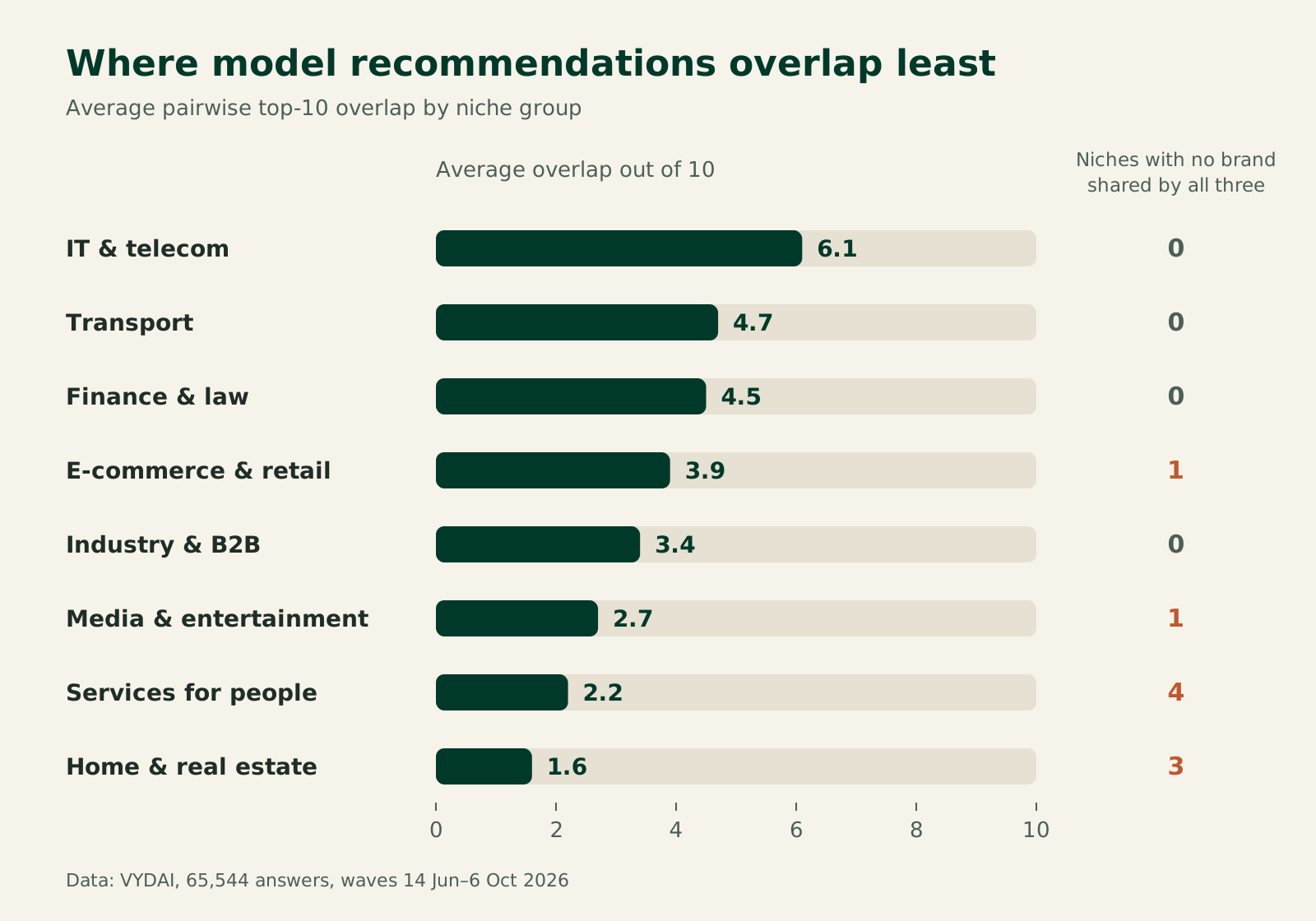
In nine categories, no brand made all three top-10s: beauty salons and spas, psychologists and coaches, landscaping, veterinary clinics, publishing and print, household services, optics, construction and renovation, and restaurants and cafes.
| Category group | Niches | Mean pair overlap, out of 10 | Niches with no shared brand |
|---|---|---|---|
| IT & telecom | 4 | 6.1 | 0 |
| Transport | 3 | 4.7 | 0 |
| Finance & law | 5 | 4.5 | 0 |
| E-commerce & retail | 16 | 3.9 | 1 |
| Industry & B2B | 4 | 3.4 | 0 |
| Media & entertainment | 3 | 2.7 | 1 |
| Services for people | 10 | 2.2 | 4 |
| Home & real estate | 4 | 1.6 | 3 |
In psychology and coaching, the three top-10s contained 30 different names across 30 slots. Gemini more often named Ukrainian services Rozmova (44%) and Treatfield (34%); GPT included international platforms Talkspace (22%) and BetterHelp (22%). This describes model responses, not service quality or what Ukrainian customers choose.
The beauty salon lists also had no overlap. GPT did not return a usable answer for 367 of 450 prompts in this category, so we compare successful answers only.
Why the gap is largest where there are no clear leaders
Categories where leading brands appeared more often in answers also had more overlap between model lists. Across the 49 categories, the correlation between mean top-10 brand coverage and mean pair overlap was 0.74. This is an association between two measures, not evidence that popularity causes agreement.
| Mean coverage of top-10 brands | Niches | Mean pair overlap, brands out of 10 | Mean brand shared by all three | Niches with none shared |
|---|---|---|---|---|
| Under 25% | 15 | 1.67 | 0.73 | 9 |
| 25–40% | 15 | 3.67 | 2.47 | 0 |
| 40% or more | 19 | 4.91 | 3.53 | 0 |
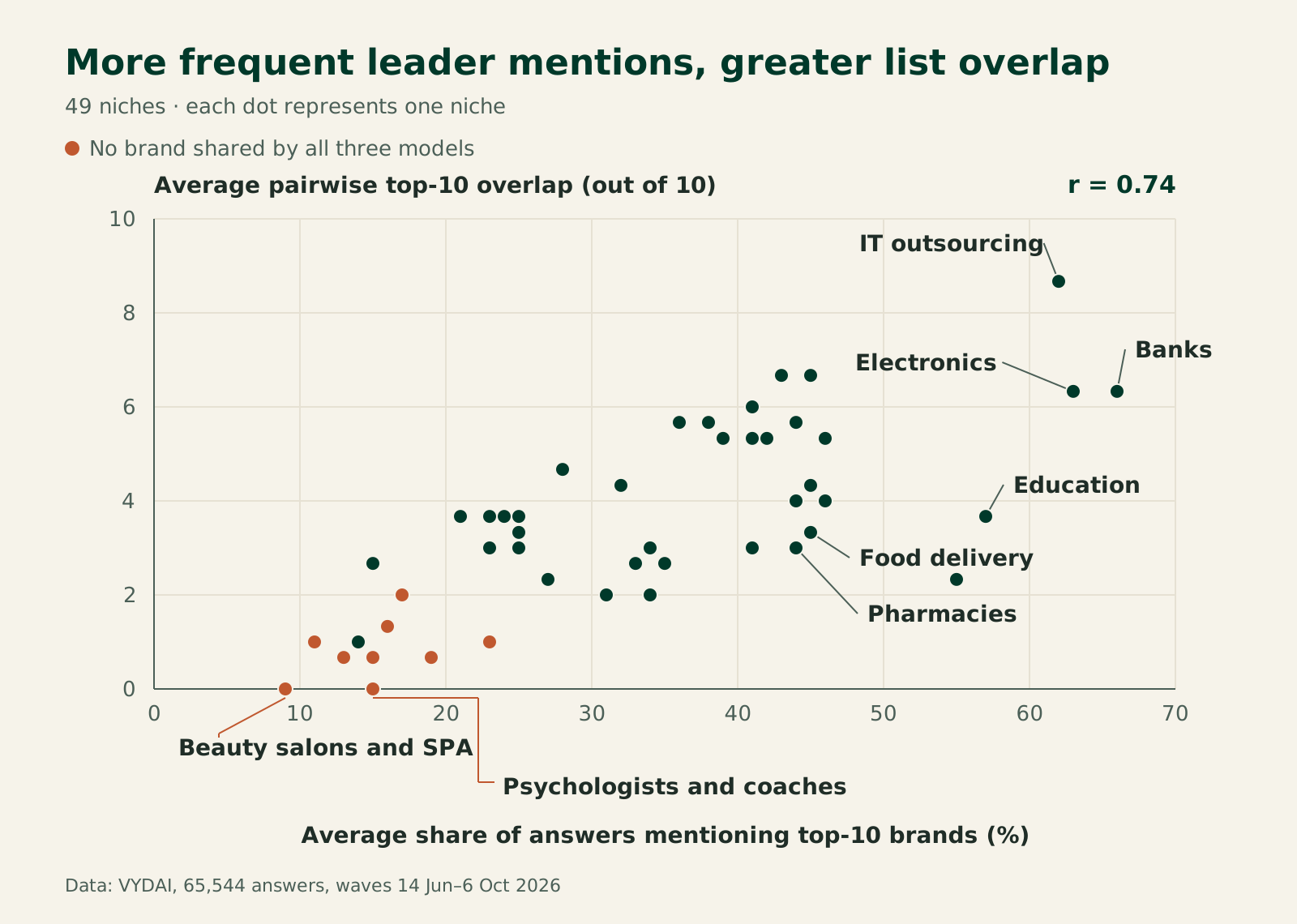
All nine categories with no brand shared by the three models fell into the low-coverage group. A practical rule follows: if even the most frequently named brands appear in fewer than about one-quarter of answers, check each model's list separately. For example, the most frequent beauty-salon entries were in only 14% of Claude answers and 26% of Gemini answers. In banking, each model named its leader in 88–95% of answers.
The rule only works one way: high coverage does not guarantee agreement. In insurance, top-10 brands appeared in 55% of answers on average and in education in 57%, yet each niche had only one brand in all three top-10s. Each model confidently names its own leaders, as the education example below shows.
Pharmacies, food delivery, education, and banks: what each model named
The tables show the five most frequently named brands in each category. Percentages are the share of successful answers from that model that mentioned the brand, not market share. These examples come from Ukrainian prompts, so some names may be unfamiliar outside the country.
| Pharmacies | Claude | Gemini | GPT |
|---|---|---|---|
| Top five | Apteka24.ua 56%, Apteka.ua 44%, Farmak 36%, Liki24 18%, eapteka.ua 16% | Podorozhnyk 100%, ANC 99%, Dobroho Dnia 92%, Apteka.ua 90%, 9-1-1 85% | Apteka24.ua 97%, Watsons 86%, Apteka.ua 50%, Pharmacity 40%, eapteka.ua 39% |
Gemini named large Ukrainian offline pharmacy chains: Podorozhnyk, ANC, and Dobroho Dnia. Claude and GPT leaned more toward online services such as Apteka24.ua, Liki24, and eapteka.ua. Podorozhnyk appeared in 99.8% of Gemini answers, 13.3% of GPT answers, and 0.7% of Claude answers. Claude's list also included Farmak, a pharmaceutical manufacturer rather than a pharmacy chain. Watsons, a health and beauty retail chain, appeared in 86% of GPT answers.
| Food delivery | Claude | Gemini | GPT |
|---|---|---|---|
| Top five | Uber Eats 94%, Wolt 78%, local florists through Glovo 68%, 2GIS 37%, Bolt Food 24% | Glovo 88%, Bolt Food 86%, Mafia 70%, Domino's Pizza 54%, Sushi Master 45% | Glovo 87%, Uber Eats 86%, Wolt 62%, Eda.ua 52%, Foody.ua 47% |
The "local florists through Glovo" entry in Claude's list is an artifact of the answer or of brand extraction, not a separate service; we did not edit the top list by hand. Claude named Uber Eats in 94% of answers and GPT in 86%. However, Uber announced that Uber Eats would cease operations in Ukraine on June 3, 2020. Wolt appeared in 78% of Claude answers and 62% of GPT answers, although Ukraine is absent from Wolt's current country list. Bolt Food has a courier recruitment page for Ukraine, and Gemini named it in 86% of answers. A mention in a model response alone does not confirm that a service currently operates in the country. Our ghost brands study looks at why models keep recommending services that left Ukraine and what a brand can do about it.
| Education | Claude | Gemini | GPT |
|---|---|---|---|
| Top five | Prometheus 80%, Coursera 72%, Udemy 58%, Skillbox 44%, Mate academy 36% | Projector 97%, Mate academy 96%, Hillel IT School 87%, GoITeens / GoIT 86%, Prometheus 84% | GoIT 93%, Prometheus 85%, Hillel IT School 82%, IT Step Academy 59%, Beetroot Academy 55% |
Prometheus is a Ukrainian online course platform, and Projector is a Ukrainian online school for creative and tech professions. Projector appeared in 97.3% of Gemini answers but 1.8% of Claude answers. Coursera appeared in 71.6% of Claude answers, 54.2% of GPT answers, and 7.3% of Gemini answers. Prometheus made all three top-10s, with coverage ranging from 80.2% to 84.7%. Skillbox, a Russian online school, appeared in 44.0% of Claude answers, 0.7% of GPT answers, and none of Gemini's. Our ghost brands study reports 51% for Claude because it counted names in the answer text rather than in the list returned by the automatic brand extractor.
| Banks | Claude | Gemini | GPT |
|---|---|---|---|
| Top five | PrivatBank 88%, PUMB 88%, Ukrsibbank 87%, OTP Bank 75%, A-Bank 72% | PrivatBank 93%, PUMB 92%, Raiffeisen Bank Aval 91%, monobank 88%, Oschadbank 88% | PrivatBank 95%, Oschadbank 93%, PUMB 83%, OTP Bank 70%, monobank 61% |
PrivatBank ranked first in all three lists, with coverage from 88.2% to 94.9%. monobank, a Ukrainian app-only bank, appeared in 88.4% of Gemini answers, 60.9% of GPT answers, and 4.9% of Claude answers. Oschadbank, a Ukrainian state-owned bank, appeared in 93.1% of GPT answers, 87.6% of Gemini answers, and 2.9% of Claude answers. Even in banking, where top brands were often shared, the visibility of a particular brand depended on the model.
What other studies found
These results can be compared with other research only with care because prompts, models, collection methods, and metrics differ.
| Source | Comparison | Result reported on the study page | Difference from our test |
|---|---|---|---|
| BrightEdge, June 2026 | ChatGPT and Gemini top-five lists by category | About two shared brands out of five per category; 4 of 5 in technology and 1 of 5 in finance and insurance | Different categories, two services, and weekly data |
| Underneath Research, version 1.1 | 80 questions to four assistants, explicit recommendations only | Jaccard from 0.284 for ChatGPT and Claude to 0.355 for Gemini and Perplexity; 66.3% of option and question combinations were recommended by only one assistant | ChatGPT and Gemini via web apps set to the US, Claude Haiku 4.5 and Perplexity via API with web search; one run per question |
| SparkToro, January 2026 | Repeated runs of 12 prompts, 600 volunteers, 2,961 answers | The chance of repeating a full list was below 1 in 100 for ChatGPT and Google AI | Measured repeatability of individual answers, not top-10s aggregated across waves |
BrightEdge reported about two shared brands out of five in each category; our pairs shared 2.9 to 4.3 out of ten. Both point to partial overlap, but the figures should not be compared directly because the samples and methods differ. Our wave-based control adds a separate check: each model's aggregated list remained stable even when models disagreed with one another.
How many AI models should you monitor?
Start with the systems your audience actually uses, then compare each model separately. When local services have low overlap, add models before treating one list as a view of the whole market.
| If this describes your situation | Practical decision |
|---|---|
| Customers may use several assistants | Track each model that matters to your audience separately |
| Your niche has established leaders, as in banking, electronics, or IT outsourcing | Check whether positions below the leaders differ; a less frequent second-model check may be enough if decisions do not depend on it |
| You work in a local service niche without a clear overall leader | Do not extend one assistant's result to the others; compare every model you can access |
| You need to assess change over a month or quarter | Keep prompts, language, and measurement period consistent |
For a fair comparison, fix the prompt set and repeat it under the same conditions. Our guide explains how to choose prompts for AI visibility monitoring. If a competitor appears in only one model's results, review the context and sources with our guide to why AI recommends competitors.
So, do AI models recommend the same brands? Only partly. Read brand recommendations by model first, then compare them. A simple first step: check how often models name the leaders in your niche. If even they appear in fewer than a quarter of answers, one report leaves much of the difference out of view, so measure visibility in each model separately.
Study limitations
These findings describe specific API models responding to fixed Ukrainian prompts. They do not show how the consumer ChatGPT, Gemini, or Claude apps respond, where models, search, memory, personalization, and system settings may differ. Web search was off in our runs.
The instruction asked models to name 7 to 12 companies. We extracted brand names in a separate step using a structured schema. We counted the share of successful answers that mentioned a brand, not sentiment or the strength of an endorsement. Thus, “top 10” means the ten most frequent mentions under our method, not necessarily ten explicit recommendations.
Twenty-four of 147 lists had a tie at the tenth and eleventh positions; we broke ties alphabetically by normalized brand name. This can change pair overlap by about one brand. Name normalization was incomplete, so the true overlap may be somewhat higher.
GPT-5 nano did not complete 601 of 22,050 requested answers. Failures were concentrated in local services, including beauty salons, dentists, and psychologists. These were not counted as answers with no brands. Coverage and top-10s for this model use successful answers only.
The 0.74 correlation between top-brand coverage and overlap does not establish causation. We did not test how results would change with web search, another instruction, different prompts, or newer API model versions. Findings apply to these 49 categories and the period from June 14 to October 6, 2026.
Frequently asked questions
Do ChatGPT and Gemini recommend the same brands?
Only partly. In our comparison, OpenAI was represented by GPT-5 nano through the API and Google by Gemini 3.1 Flash-Lite. Their top-10s shared 3.4 of 10 brands on average and matched completely only in IT outsourcing.
Do ChatGPT and Claude recommend the same brands?
More often than the other pairs, but still less than half the list. The top-10s for GPT-5 nano and Claude Haiku 4.5 shared 4.3 brands on average out of ten, from 0 to 8 depending on the niche.
Do these results apply to the ChatGPT, Gemini, and Claude apps?
No. We tested three API models without web search. The result should not be transferred to consumer apps, which may use different models, search, and personalization.
Is the disagreement just random noise?
Across nine waves, each model's top-10 list overlapped between odd and even waves by 8.53–9.20 brands out of ten, while different models shared only 2.90–4.24. That describes stability of aggregated lists in this period, not a guarantee that an individual answer will stay the same.
How many AI models should you monitor?
At least the models your audience uses and that affect your marketing decisions. For a local category without strong leaders, compare every model available because differences may be largest there.
Why might VYDAI's public rating show different figures?
The public rating factors in a brand's position in an answer. This study's top-10 uses the frequency of brand mentions in successful answers. The measures are related but not identical.
How we do it in VYDAI
In the VYDAI workspace, the Competitors report breaks down mentions and the brand description by model, the Sources report can be filtered by model, and each answer example opens with its prompt, date, and model. The platform monitors ChatGPT, Gemini, Claude, Google AI Overviews, and Google AI Mode. It does not monitor Perplexity. Open the VYDAI demo or create a project to review these views with your own prompts.