GEO for B2B means making sure that when a buyer asks AI to compare vendors, your company is described with accurate facts and evidence. GEO for IT companies starts with clear information about their expertise, work model, experience, and limits. Gartner surveyed 645 B2B buyers, and 45% used generative AI mainly to research vendors and products. In VYDAI's September 20, 2026 IT outsourcing measurement, SoftServe appeared in 98% of 50 Ukrainian prompts. Even for a small business in Chernivtsi, ChatGPT named SoftServe, ELEKS, and EPAM. When a buyer asks how AI chooses a vendor, that list still needs to be checked against the buyer's budget and task.
How B2B buyers use AI to choose vendors
A buyer may begin with an unclear problem, such as a slow release cycle. They can ask AI to define the type of solution, compare companies with a particular technology stack, and prepare questions for a vendor call. A CTO may ask about architecture and security. Finance may ask how billing works, while procurement checks contract terms. AI can help form an initial longlist, but the buying team still has to validate the options.
According to G2's 2025 Buyer Behavior Report, based on 1,169 B2B respondents, nearly eight in ten said AI search had changed their research process, and 29% said they start research on platforms such as ChatGPT more often than on Google. These findings describe that survey sample, not every B2B purchase.
In January 2025, 77% of the 2,058 technology buyers surveyed in TrustRadius's B2B Tech Buying in the Age of AI study said they read user reviews during a software purchase. The survey also included 490 technology vendor professionals. A vendor's own site needs to hold up when buyers compare it with customer experience shared elsewhere.
In Gartner's survey of 645 B2B buyers conducted in August and September 2025, respondents used an average of seven information sources, and 69% wanted to validate AI insights with a sales representative. GEO should prepare both the answer that earns consideration and the evidence needed for the next conversation.
What GEO changes for B2B compared with B2C
A B2C purchase often involves an individual choosing a product by price and features. In B2B, a buyer has to explain the decision to other stakeholders, anticipate implementation risks, and show how a product or service fits existing work. IT services add questions about team composition, data access, support responsibilities, and project boundaries.
| Dimension | B2C | B2B SaaS | IT services |
|---|---|---|---|
| Who decides | An individual or household | Users, a department lead, security, and procurement | A business owner, CTO, team lead, and procurement |
| What they compare | Price, features, and availability | Use cases, integrations, security, and licenses | Industry experience, stack, team, process, and accountability |
| Example prompt | “Which phone is best for photos?” | “Which CRM connects to our accounting system?” | “Which team can build a Go service and support it after launch?” |
| Evidence for the decision | Specifications and reviews | Demo, documentation, reviews, and terms | Contextual case studies, team details, SLA, and references |
| Risk of a poor fit | A bad purchase | Migration cost and low adoption | Delays, lost knowledge, security problems, or weak support |
SEO helps B2B pages appear in conventional search. Generative engine optimization for B2B adds a related question: can an AI system assemble a clear answer about your product or service from the information it can access? The work shares foundations with SEO, including accessible pages, useful content, and clear structure. Google says its usual search requirements apply to AI Overviews and AI Mode: a page must be indexed and eligible to appear with a snippet. Meeting those requirements does not guarantee a placement. Google's documentation on AI features in Search explains the conditions.
Some teams use the term B2B answer engine optimization for improving a company's presence in systems that generate answers. The practical work remains focused on buyer questions, verifiable claims, and sources that substantiate a company's expertise. AI search in B2B adds specific buying situations and a higher cost of a mismatch. A broad page that says “we build software” does little to explain whether a team fits a fintech product, SLA-based support, or a legacy migration.
Examples of B2B buyer prompts at each stage
The table combines editorial test prompts with English translations of real prompts from the VYDAI IT outsourcing rating pool. The rating prompts were written in Ukrainian. The English text below is a translation, not the exact wording submitted to the models. Check whether each answer names relevant vendors, what evidence it gives, and which buyer constraints it addresses.
| Stage | Role and prompt | Origin and what to verify |
|---|---|---|
| Problem framing | CEO: “How can we shorten time from idea to release if we do not have an in-house development team?” | Editorial test prompt. Check whether the answer distinguishes hiring, consulting, an external team, and off-the-shelf software |
| Longlist | Founder: “Which Ukrainian or Polish IT services firms support EU and US clients in fintech and have payment systems experience?” | Editorial test prompt. Verify the stated market and relevant fintech work |
| Shortlist and comparison | “I am looking for IT outsourcing companies in Kyiv. Recommend a shortlist of reliable providers, compare their pricing proposals, timelines, and reliability, and say which options are worth considering.” | English translation of a prompt from the VYDAI rating pool. Check price, timelines, and reliability evidence |
| Comparison | “I want to compare IT service providers in Ukraine. Which companies are considered best for code quality, meeting deadlines, and project cost?” | English translation of a prompt from the VYDAI rating pool. Check quality, delivery, and cost evidence |
| Risk and SLA | “I need outsourced IT infrastructure support in Kyiv. Which companies should I consider? Compare their SLAs, response times, and prices.” | English translation of a prompt from the VYDAI rating pool. Check response commitments and cost |
| Price and engagement | “I am looking for IT services companies in Odesa for outsourced software development, with a budget of up to $1,500 a month. Recommend options and compare portfolios and timelines.” | English translation of a prompt from the VYDAI rating pool. Check budget fit, portfolio, and delivery timeline |
A procurement lead may ask about billing currency, deposits, and how scope changes affect the agreement. A product lead evaluating SaaS may focus on integrations, while an information security reviewer checks data access and storage. Keep these intents separate in a monitoring set rather than blending them into one average result. The guide to choosing AI visibility prompts explains how to build a useful set without turning every variation into a separate test.
Start with 20 to 30 questions that already appear in sales calls, briefs, and email. Tag each by buying stage, role, market, solution type, and decision criterion. One prompt may ask whether a vendor integrates with SAP, while another may ask for an option that fits a startup budget. Do not judge a company for missing a scenario it does not serve.
How AI chooses a vendor: model knowledge and web search
Depending on the mode, a system may answer from knowledge formed during training or retrieve current web pages. The first mode is slower to change. The second can point to current documents, profiles, and discussions. An answer without citations does not reveal which URLs shaped it, so it cannot be used to conclude that a particular directory or review influenced a recommendation.
The public VYDAI IT outsourcing rating measured brand mentions across 50 prompts, all written in Ukrainian. The September 20, 2026 run produced 150 successful answers, one from each of ChatGPT, Claude, and Gemini for each prompt. Web search was off and the answers contained zero cited URLs. The rating therefore shows which names these models produced from their available knowledge for this prompt set. It is not a source map or a rating of vendor quality.
To study sources in web-enabled answers, run separate prompts with web search and save the cited links. Compare the same scenarios across systems and repeat the checks. A guide to the differences between systems is available in how ChatGPT, Gemini, Claude, and Perplexity choose brands.
Which IT outsourcing companies does ChatGPT recommend: VYDAI rating data
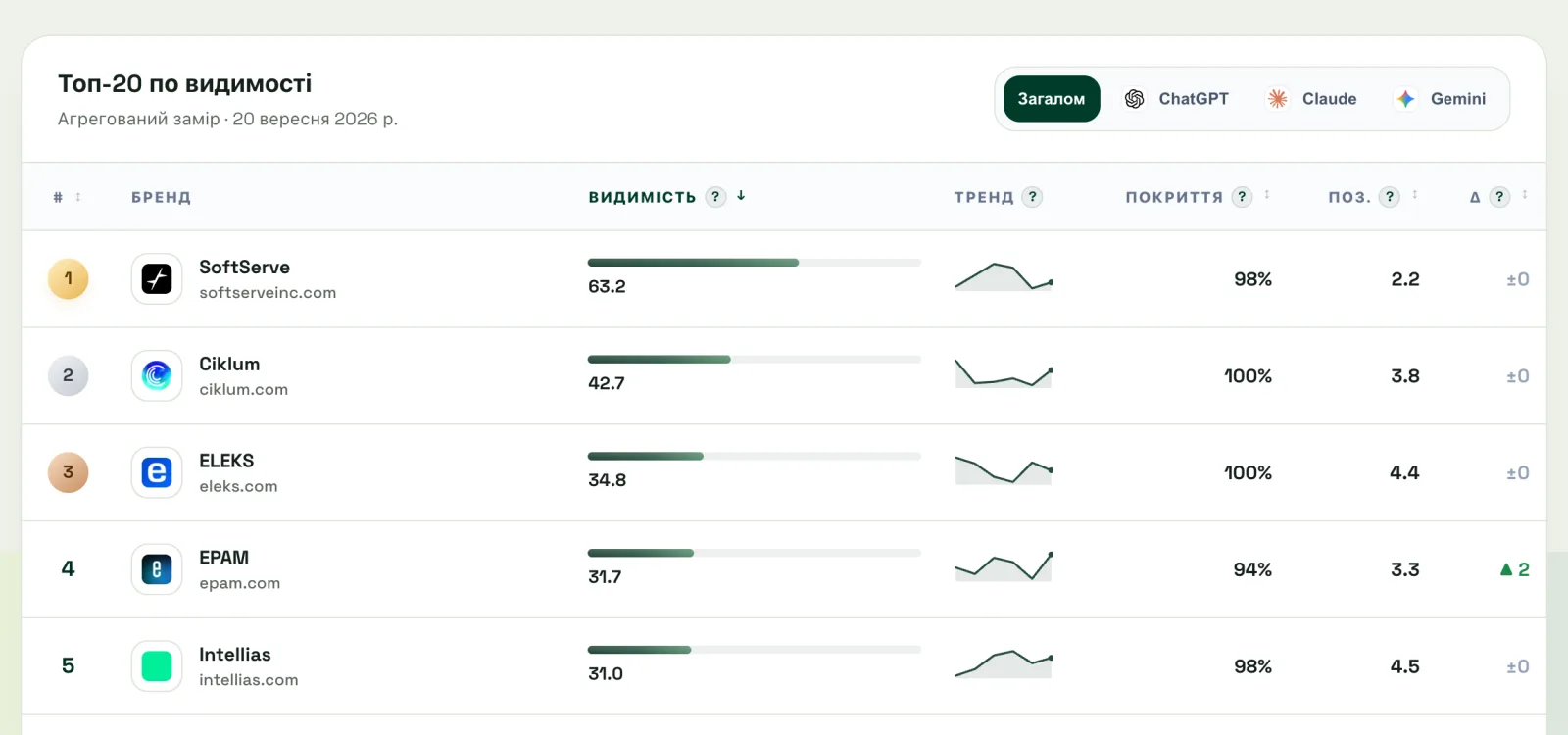
In the overall IT outsourcing snapshot dated September 20, 2026, SoftServe had the highest visibility score among the companies in the measurement. The table shows score, prompt coverage, and average position. Average position is calculated for answers where the company appeared. The score does not measure service quality, revenue, or client satisfaction.
| Company | Score | Prompt coverage | Average position |
|---|---|---|---|
| SoftServe | 63.2 | 98% | 2.2 |
| Ciklum | 42.7 | 100% | 3.8 |
| ELEKS | 34.8 | 100% | 4.4 |
| EPAM | 31.7 | 94% | 3.3 |
| Intellias | 31.0 | 98% | 4.5 |
| N-iX | 27.3 | 96% | 5.1 |
| DataArt | 21.8 | 92% | 6.3 |
| Sigma Software | 19.4 | 84% | 6.1 |
| Infopulse | 14.4 | 84% | 6.6 |
| GlobalLogic | 11.2 | 68% | 7.2 |
The same prompt set produces a different order in each model. This table gives each provider's rank within the model and its score in parentheses. Full results and methodology are on the VYDAI IT outsourcing rating page (in Ukrainian).
| Rank | ChatGPT | Claude | Gemini |
|---|---|---|---|
| 1 | SoftServe (74.7) | SoftServe (53.4) | SoftServe (61.5) |
| 2 | Ciklum (59.4) | Ciklum (43.7) | Intellias (33.2) |
| 3 | ELEKS (54.3) | ELEKS (28.5) | EPAM (33.1) |
| 4 | EPAM (48.8) | Intellias (26.0) | Sigma Software (26.7) |
| 5 | N-iX (36.5) | N-iX (23.9) | Ciklum (24.9) |
EPAM ranks fourth in ChatGPT and seventh in Claude. Intellias is second in Gemini and sixth in ChatGPT, while SoftServe leads all three systems.
What AI recommends to small businesses in regional markets
The four locations below are Ukrainian cities, and each original rating prompt was in Ukrainian. ChatGPT repeatedly put large exporters near the top, including in a small business scenario with a monthly budget of $1,500. Claude and Gemini more often returned local names, but buyers need to verify their service category and fit. Claude included Vodafone Ukraine and 3Com in its answer about small business IT services in Chernivtsi. Gemini included Netpeak, a marketing agency, in a list for outsourced development in Odesa. For a small regional provider, this is an opening: clear public evidence about location, team size, budget range, and case studies can earn consideration where AI currently lists names a buyer must check.
| Ukrainian city and prompt | ChatGPT, first five | Claude, first five | Gemini, first five |
|---|---|---|---|
| Lutsk, IT services partners for business growth | ELEKS, SoftServe, EPAM, Intellias, N-iX | Softinfo, DataCloud Solutions, TechHub Lutsk, ProDev Studio, IT-Auditing Partners | IdeaSoft, InternetDevels, INLIGHT Digital, Volodymyr Tech, IT-Solutions |
| Rivne, IT maintenance and outsourcing, SLA and cost | Ciklum, ELEKS, N-iX, SoftServe, EPAM | ITELLIGENCE Ukraine, Interservice, Webstudio Taras, SoftServe, Exon | IT-SERVICE, LanService, SoftGroup, Infotech, ProIT |
| Chernivtsi, IT services for small businesses | SoftServe, ELEKS, EPAM, Infopulse, Intellias | Vodafone Ukraine, 3Com, WebPoint, ITS Group, Fastnet | SoftServe, Ciklum, Infopulse, GlobalLogic, Datagroup |
| Odesa, outsourced development, budget up to $1,500 per month | Ciklum, ELEKS, SoftServe, EPAM, Intellias | SoftServe, Sigma Software Group, Innovecs, DataArt, Ciklum | Netpeak, Quintagroup, CodeIT, Synergy Way, Artjoker |
On average, one answer named 9 to 10 companies, and more than 100 distinct company names appeared across the prompt set. A regional provider should show evidence for its specific city and scenario rather than compete only for a generic list of well-known IT companies.
Concentrated and fragmented B2B niches
The gap between the first and tenth company indicates how far the leader is ahead in the rating. The number of distinct brands in the top 20 across three systems shows how widely mentions are distributed.
| Niche | Overall leader | Leader score | Gap from #1 to #10 | Brands in the top 20 across three systems |
|---|---|---|---|---|
| IT outsourcing | SoftServe | 63.2 | 52.0 | 37 |
| SaaS and software | Bitrix24 | 16.9 | 7.42 | 36 |
| Marketing agencies | Netpeak | 74.5 | 67.9 | 52 |
In a concentrated niche, compete for specific sub-intents such as stack, industry, city, or budget instead of the generic “top IT companies” query. In a fragmented niche, a clear category position can help a company enter the broader answer. For example, Bitrix24 leads the overall SaaS rating with 16.9, while Gemini's leader is KeyCRM with 28.3. To understand why AI names competitors, compare answers for your target subcategories. Public ratings remain snapshots of a specific prompt set, not rankings of the best vendors.
Sources AI uses for B2B recommendations
With web search enabled, AI may cite third party pages. Content agency Foundation and AI visibility tool vendor AirOps studied 50 B2B brands across seven verticals, tracking 5.1 million responses and 57.2 million citations over 60 days. In their dataset, Reddit made up 20.8% of external citations, YouTube 13%, LinkedIn 11%, support documentation 8%, and G2 and similar review sites 4%. Reddit's share rose to 30.9% for unbranded discovery prompts, the “which vendor should I choose?” searches that can shape a shortlist before a buyer names a brand. This is a co-produced study on a limited set of brands, not a universal distribution for every model or IT firm, as the Foundation and AirOps citation analysis explains.
Treat these shares as a reason to inspect your own category, not as a channel checklist. IT services may depend on directories and professional communities, while SaaS buyers may rely on product catalogs, documentation, and comparisons. Review how to analyze the sources AI relies on to build a source map from citations. The guide to AI trust sources, including websites, PR, directories, and reviews explains how these forms of evidence differ.
| Source type | Buyer question it can help answer | What the company can do | Limit |
|---|---|---|---|
| Company website | What problem, industry, and technology do you serve? | Separate service, solution, industry, and location pages | A company's own claims need outside evidence |
| Client case studies | Have you done similar work? | Explain context, team, stack, scope, duration, and verified outcomes with permission | Do not claim impact that was not measured |
| Comparison pages | How do you differ from alternatives? | Compare solution models against the same criteria | Do not present a promotional claim as an independent review |
| Pricing and engagement pages | What will this cost and how does a team work? | Explain rates, ranges, or pricing factors and how scope changes | Avoid false precision before discovery |
| Clutch and GoodFirms | What do customers say about an agency or vendor? | Keep profiles and specializations current and ask for honest reviews | A profile does not prove experience in every project |
| G2, Capterra, Gartner Peer Insights, TrustRadius | How do buyers assess a software product? | Maintain the right category, current profile, reviews, and product details | A catalog may not cover local service models |
| DOU.ua | What is publicly known about a Ukrainian IT company? | Keep the company description consistent with its public information | Not every detail there assesses service quality |
| Who works there and what expertise do they share? | Maintain company and expert profiles and publish useful experience | A post does not prove completed client work | |
| Reddit, Hacker News, Stack Overflow, and forums | How does the team solve technical problems? | Give useful answers and link documentation when relevant | Do not buy recommendations or flood communities with promotion |
| GitHub and documentation | Can a buyer inspect an API, integration, library, or code example? | Publish clear READMEs, version notes, and examples | Open source does not prove the quality of the whole service |
| Wikipedia | Is important company information supported by independent sources? | Build accurate independent coverage if the company meets notability rules | A Wikipedia page is not an advertising profile |
| Press and analyst coverage | Which company or category facts have outside support? | Give editors accurate facts, subject matter experts, and useful comments | A press mention does not replace client evidence |
| IT Ukraine Association and other trade groups | What industry does the company belong to? | Keep member profiles and areas of expertise current | Membership does not guarantee a recommendation |
| YouTube and webinars | How does an expert explain a product or technical decision? | Publish demos, walkthroughs, and answers to buyer questions | Videos can go stale, so date them and link current details |
IT Ukraine Association's member directory uses specializations such as Custom Software, Cybersecurity, IT Consulting, SaaS, Software Engineering & Outsourcing, and Systems Integration. Such a taxonomy describes a company more precisely than the broad label “IT.”
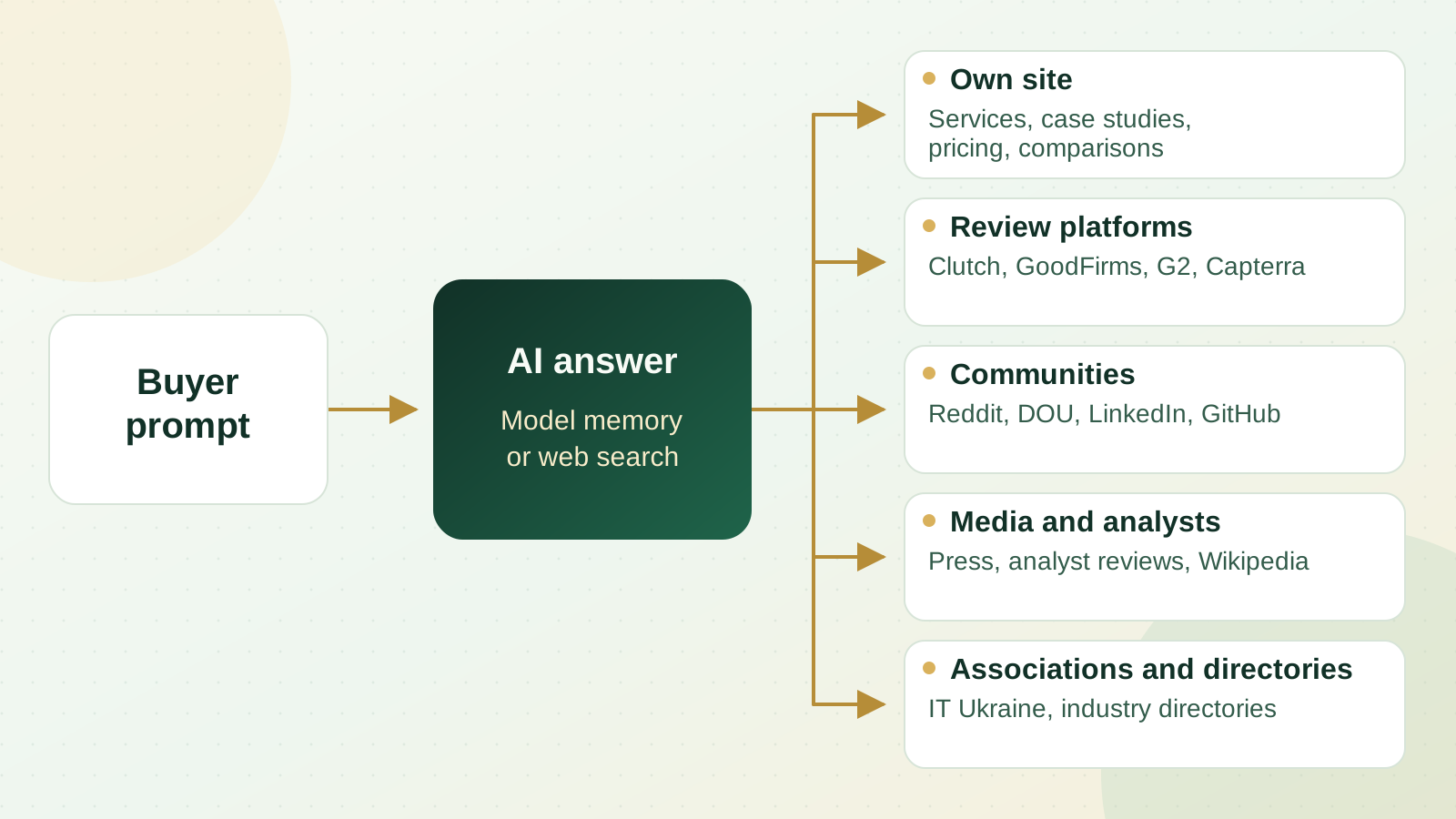
To build your own map, run the same category, alternatives, and brand prompts in a web search mode. Record each domain, page, date, and brand mention. Compare citations with the material a procurement team opens. If an answer has no sources, mark it as uncited rather than guessing where the claim came from.
GEO for IT companies and SaaS: an action plan
GEO for IT companies and outsourcing firms
An outsourcing buyer needs to know who will join the team, how its size may change, and who is accountable for delivery. Public pages should name the expertise, technologies, client type, engagement model, geography, and support options. GEO for IT companies becomes practical when a provider can show a case study for the same type of work rather than only a wall of client logos.
- State a clear position for each service line. Check: the opening of each page says what problem, industry, or technology the team actually serves.
- Add contextual case studies. Check: the reader can see the starting point, team size, stack, duration, and a verified outcome if it can be published.
- Explain how an engagement starts and runs. Check: buyers can see who scopes the work, how changes are agreed, and what support includes.
- Explain pricing and engagement models. Check: the page gives a price, range, or specific factors that shape the estimate.
- Review directory profiles. Check: names, specialties, links, and descriptions match the company site.
- Align public facts across expert profiles, DOU, and trade groups. Check: names, service lines, and locations are consistent.
- Give technical experts a place to explain their work. Check: content has a real author, examples, and a review date rather than generic expertise claims.
- Check that search engines and AI crawlers can access key pages. Check: important content is available without a complex browser interaction and structured data matches visible text.
GEO optimization for a B2B company website does not mean inserting keywords into every heading. Create pages that answer distinct needs such as industry, stack, integration, team model, budget, and security. Check for inconsistent product names, outdated figures, or conflicting terms.
GEO for B2B SaaS
For a software product, organize pages by the tasks it supports: who uses a feature, what system it replaces, which tools it integrates with, and what data it processes. Separate pages should explain plan limits, access controls, implementation, and support. GEO for B2B SaaS also includes a current G2 or Capterra profile when buyers use that catalog in your category.
An integration page should name supported versions and the direction of data flow. A security page should separate current controls from planned work. If price changes with user count or data volume, explain the pricing rule. These details help buyers compare a product and reduce questions that would otherwise repeat in a demo.
GEO for SaaS companies
Use the same evidence checks for SaaS companies, then make the product's category position clear. Explain the buyer, task, integrations, implementation, pricing logic, and security review path in language a buyer can verify. If several categories fit, explain the primary use case and link related use cases rather than describing the product as suitable for everyone.
Common GEO mistakes in B2B
| Mistake | What the buyer loses | What to do instead |
|---|---|---|
| Generic “team of professionals” description | They cannot tell which job you fit | Name the industry, project type, stack, and engagement model |
| Case studies without context | They cannot compare the work with their situation | Explain the starting point, team role, and limits of the result |
| Hidden pricing logic | They cannot rule out a poor fit | Give a range or pricing factors without false precision |
| Competitor comparisons without criteria | The page reads like an ad | Use shared criteria and point to evidence |
| Reviews written for GEO | Trust in the company and the platform can fall | Ask real clients for honest feedback without scripting it |
| One page for every audience | CTOs, procurement, and CEOs cannot find their answer | Separate scenarios and provide useful paths by role |
| Treating a no-search rating as a source map | The team may optimize the wrong site | Collect web-enabled answers separately and inspect their URLs |
Do not buy AI mentions through fabricated reviews or mass-posting. Buyers can check profiles against real case studies. Publish material that remains useful to a person even when it is not used in an AI answer.
How to measure results and how long to wait
Build a stable prompt sample by stage, role, industry, and model. For each run, save the date, wording, system, answer, brand mention, position, and cited URLs when available. Track mentions and citations separately: a company may be named without a link, or its page may be cited without a recommendation.
Repeat the same prompts on a schedule and mark content changes separately. Do not conclude from one answer because wording and model versions can change. Measure whether a mention fits the use case as well as whether it appears. A company surfaced for the wrong budget or service has visibility without a qualified fit. The AI visibility and SEO metrics guide explains coverage, position, mentions, and citations.
There is no universal time for a company to appear in AI answers. Search systems may discover a page before a model's stored knowledge changes. After publishing an update, record the date and rerun the same sample. Do not promise a fixed timeline when you do not control indexing or model updates.
Frequently Asked Questions
Does GEO for B2B matter if customers come through referrals?
Referrals remain valuable, and GEO can help a buyer check whether your company fits the task they were given. Public case studies, profiles, and clear service descriptions support that review.
How is GEO for B2B different from SEO?
SEO helps pages appear in conventional search. GEO focuses on how AI systems form a company answer from information they can access. Both benefit from accessible pages and accurate, useful content.
Do Clutch and G2 profiles affect AI answers?
Their appearance depends on the system, answer mode, and prompt. Check whether these sites are cited in web-enabled answers for your category, and keep the profiles useful and current for buyers.
Why does ChatGPT recommend large firms to small businesses?
In VYDAI's web-disabled measurement, ChatGPT often named large IT brands in regional and low-budget prompts. A name in the answer still needs to be checked against the buyer's budget, location, and required service.
How can an in-house team start GEO for SaaS companies?
Start with questions from sales, group them by stage and role, then check the pages, case studies, and external profiles that should substantiate the answer. For a technical page review, use the GEO audit checklist or the public VYDAI GEO audit.
When will AI start mentioning my company?
There is no fixed timeline. Track the same prompt set over time and separate web-enabled answers from answers without search. The IT outsourcing rating is one snapshot, not a promise of a future position.
How we do it in VYDAI
VYDAI lets a team save prompts, choose competitors, and compare answers by date. In Prompts, you can select which AI systems check each prompt, or keep all systems enabled for the project. Prompts can also be edited in bulk. Categories and tags help group them by buyer stage or role. Competitors shows which companies appear alongside your brand. Sources lists domains and pages cited in answers, with system and date filters. When an answer has no web citations, the Sources view cannot identify what the model drew on.
VYDAI monitors ChatGPT, Gemini, Claude, Google AI Overviews, and Google AI Mode. It does not monitor Perplexity. A small team can begin with a spreadsheet of 20 prompts, recording stage, role, date, system, brand mention, and cited URLs. If you want recurring comparisons, create a VYDAI account, open the demo, see the public ratings page (in Ukrainian), or open the IT outsourcing rating (in Ukrainian).
As a first step in GEO for B2B, take the four regional prompts above, substitute your city and budget, then run them in ChatGPT, Claude, and Gemini. Check whether your company appears or AI names large exporters instead, and which public evidence would help the buyer assess either option.