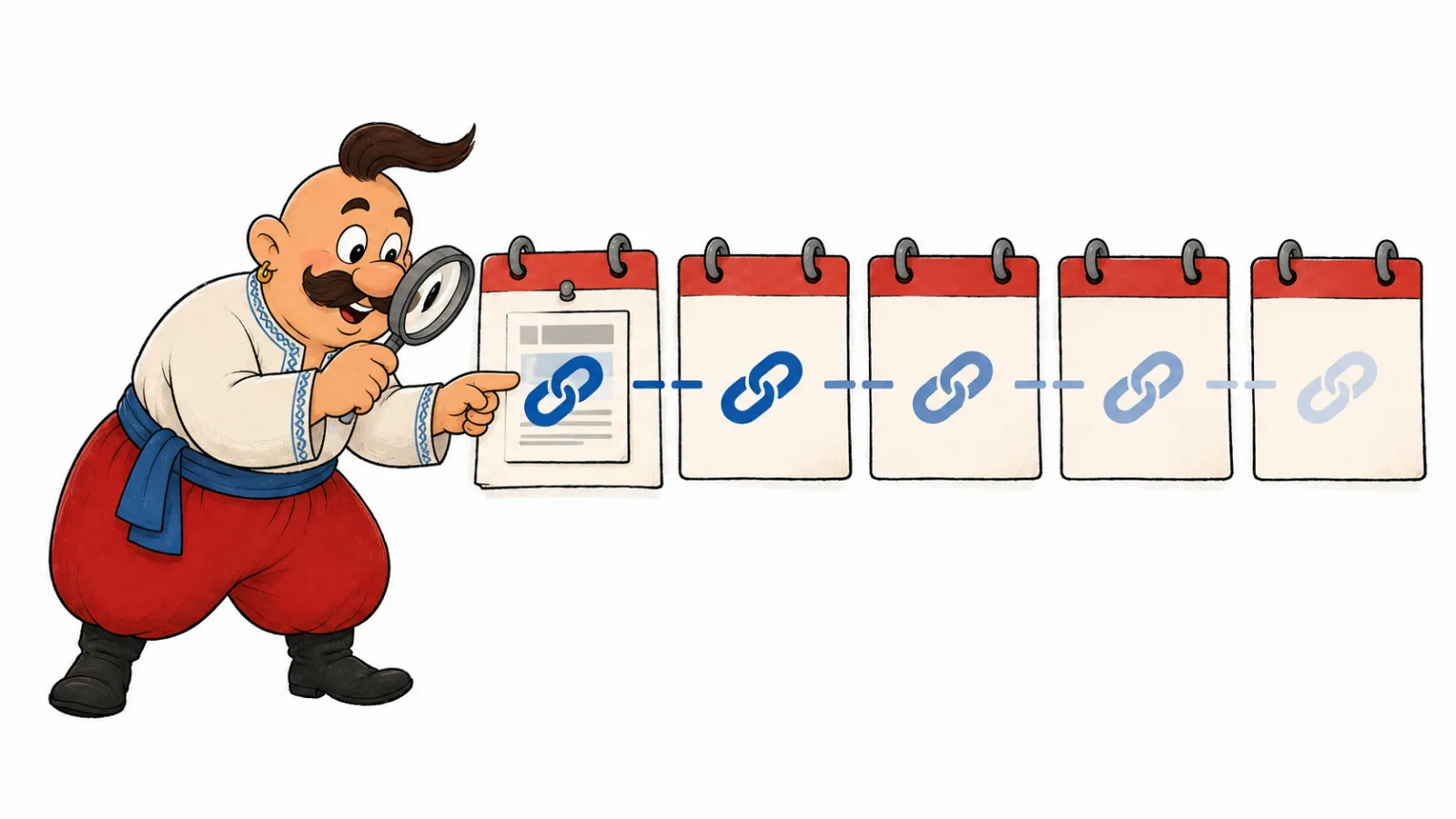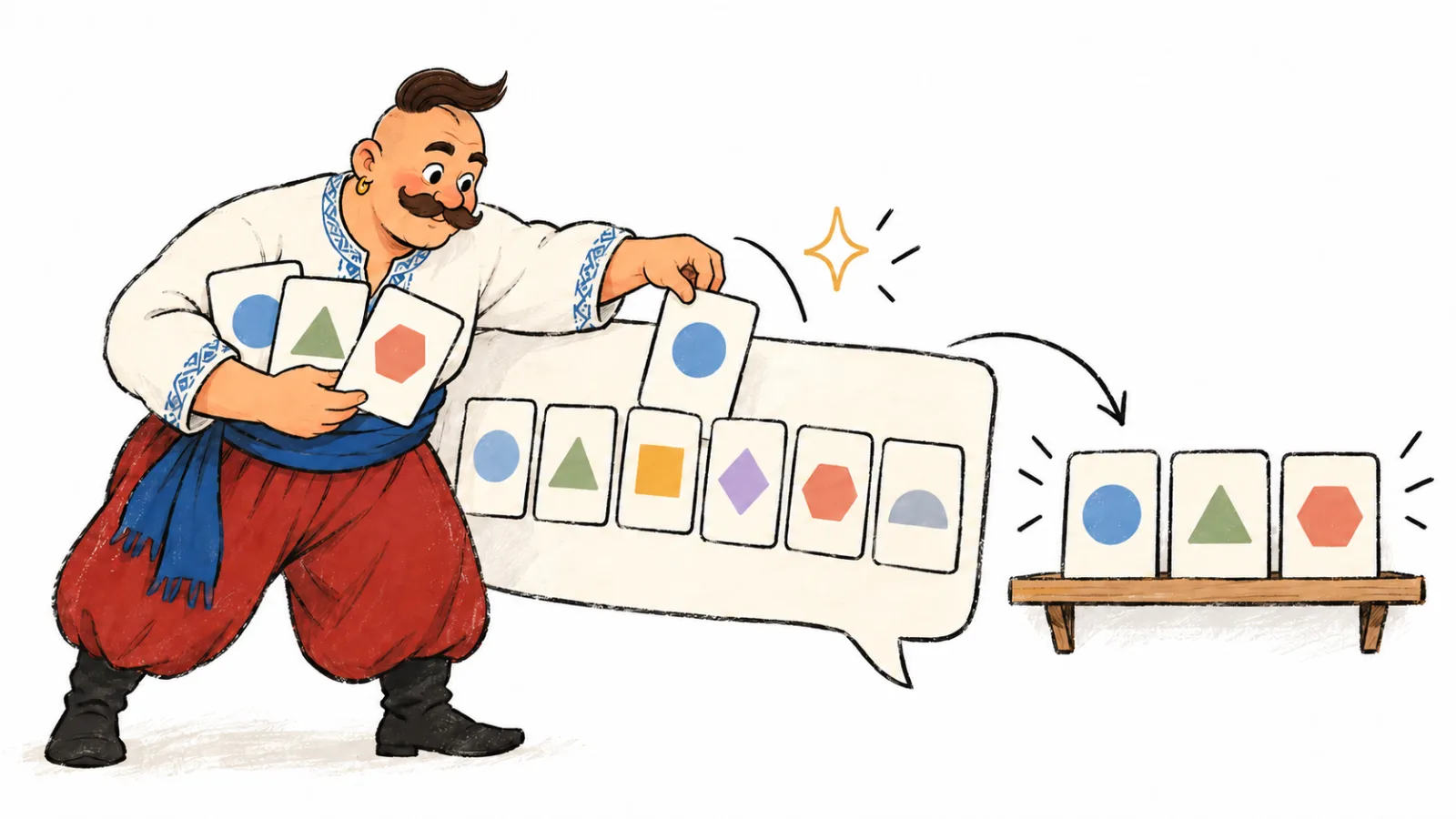
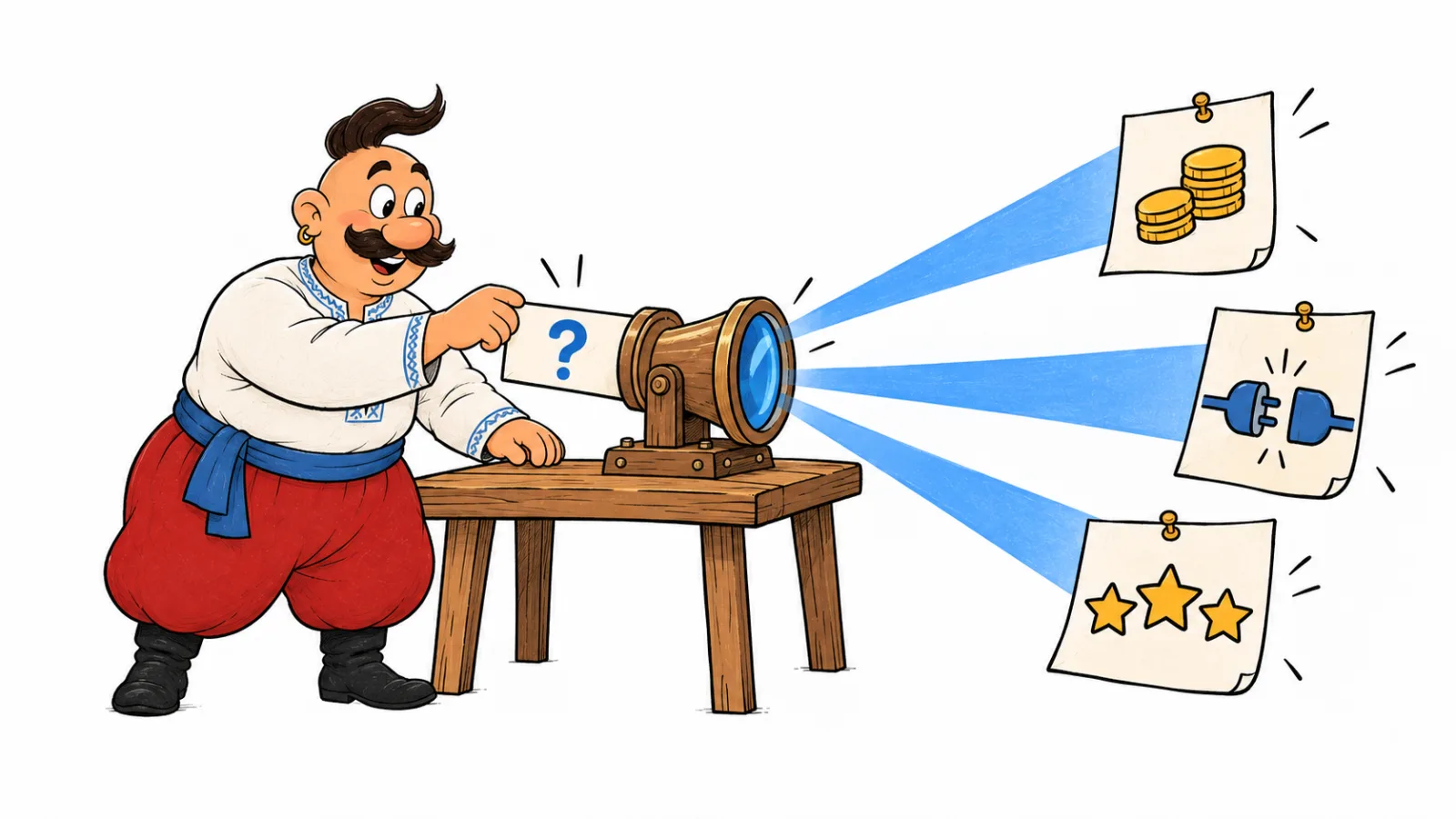
When ChatGPT searches for a buyer, it can break one broad prompt into narrower web searches for an official site, pricing, integrations, and reviews. That is ChatGPT query fan-out: one buyer intent becomes several checks. To find a content gap, record the searches the model actually ran, then map each one to the evidence and page your site provides.
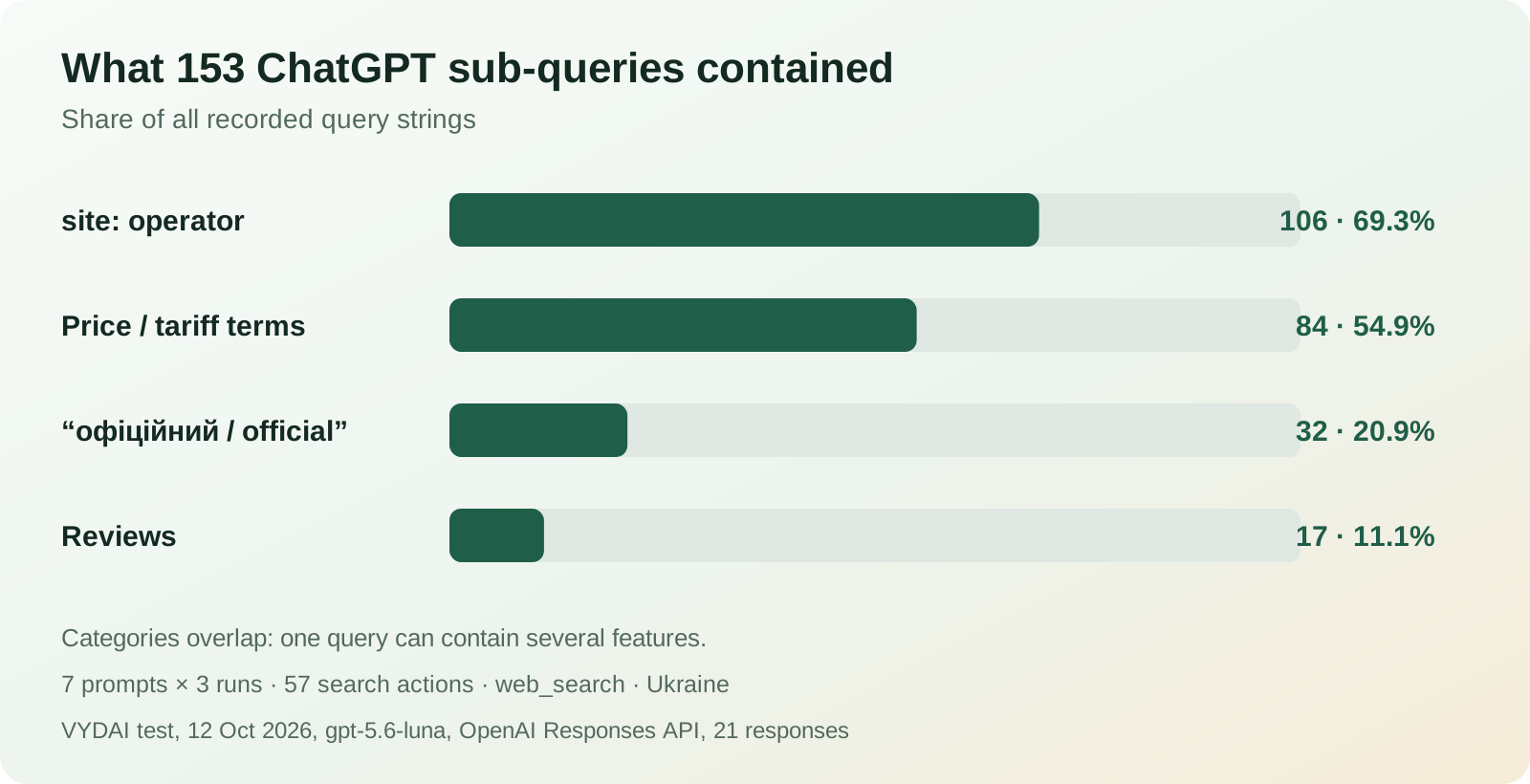
In a VYDAI test on October 12, 2026, seven Ukrainian buyer prompts about CRM for online stores triggered web search in all 21 API responses. The logs contained 153 search strings, 106 with the site: operator.
What is query fan-out in ChatGPT and when does it run?
Query fan-out is when a system turns a person's prompt into several smaller web searches. Someone asking which CRM to choose for an online store may prompt checks for features, official pricing, marketplace integrations, and reviews. The number and wording depend on the prompt and search mode.
ChatGPT does not always search the web. In a study published on October 12, 2026, Ahrefs found web search in 14.4% of 66.6 million free, logged-out GPT-5.6 Luna responses collected in August and September 2026. Among responses that searched, Ahrefs counted an average of about 1.6 fan-out queries. Search mode and prompt type determine how many searches ChatGPT runs.
All seven prompts in the test were commercial, covering CRM comparisons, prices, integrations, and reviews. The logs contained 57 search actions. One search action can contain several fan-out queries, so the number of actions and query strings differs.
For query fan-out in Google AI Mode, see Google's description of its AI Mode search approach and VYDAI's practical guide to Google AI Overviews and AI Mode. To choose the prompts you monitor, use our guide to selecting prompts for AI visibility tracking.
What does ChatGPT search before recommending a brand? Ahrefs data
Ahrefs' study of ChatGPT query fan-out analyzed 15 million fan-out queries found in 66.6 million free, logged-out GPT-5.6 Luna responses from August and September 2026. The sample covered multiple countries, and Ahrefs did not report a full language breakdown.
| Ahrefs finding | Exact figure | What it measures | What to check on your site |
|---|---|---|---|
| Web search usage | 14.4% of responses | Share of 66.6 million responses that searched | Whether the prompt needs current or external information |
| Average fan-out queries | About 1.6 | Responses that used web search only | Do not plan pages around a fixed number of sub-queries |
| Queries with the site: operator | 6.8% | Share of 15 million recorded fan-out strings; about 116,000 domains appeared | Whether important pages on your domain are accessible |
| Brand sites among frequently searched site: domains | 75.9% | Brand sites' share among common site: searches across about 160 most frequently searched domains | Whether pages with first-party facts are easy to find |
| The word official in English fan-out strings | 10.1% in August, 13.1% in September | Share of English-language fan-out strings, up 3 percentage points | Whether the official source for your brand is clear |
| The word price | 6.04% in August, 8.88% in September | Share of fan-out strings, nearly 47% relative growth in one month | Whether the price, currency, terms, and update date are visible |
| The word reviews | 2.7% in August, 3.6% in September | Share of fan-out strings, about one-third relative growth | Whether independent reviews are available |
The site: operator limits a search to a specified domain, such as site:example.com pricing.
In its October 12, 2026 publication, Ahrefs also reported that at least one official source appeared in 84.4% of factual answers about pricing, features, or companies, and in 68.3% of comparison answers in a separate sample of 20,000 US prompts.
VYDAI test: what ChatGPT searched for in the CRM for online stores niche
We gave the model seven Ukrainian buyer prompts about choosing a CRM and ran each prompt three times. The test took place on October 12, 2026 through the OpenAI Responses API with the web_search tool, the gpt-5.6-luna model, and an approximate location in Ukraine. There was no chat history. This was an API run, not the ChatGPT app. The following prompts are copied in their original Ukrainian, in the same order as the table.
Яку CRM обрати для невеликого інтернет-магазину в Україні?
Порівняй KeyCRM і SalesDrive для інтернет-магазину
Скільки коштує CRM для інтернет-магазину в Україні?
Яка CRM має інтеграцію з Новою поштою, Rozetka і Prom?
Які відгуки про KeyCRM? Чи варто на неї переходити?
Яка CRM найкраще підходить для магазину, що продає через Instagram, в Україні?
Чи є CRM для інтернет-магазину з безкоштовним тарифом?
| Buyer prompt, English gloss | Recorded strings across three runs | Domains in site: searches in all three runs | Other actions in the logs |
|---|---|---|---|
| Which CRM should a small online store in Ukraine choose? | 8 / 10 / 11 | salesdrive.ua, keycrm.app, keepincrm.com | 8 search actions |
| Compare KeyCRM and SalesDrive for an online store | 7 / 3 / 7 | keycrm.app, salesdrive.ua | Opened pricing and feature pages |
| How much does a CRM for an online store in Ukraine cost? | 6 / 7 / 4 | No domain appeared in a site: search in all three runs | Opened a pricing page and used find_in_page |
| Which CRM integrates with Nova Poshta, Rozetka, and Prom? | 8 / 8 / 8 | keepincrm.com, keycrm.app, salesdrive.ua | Searched for integration pages |
| What are the reviews of KeyCRM? Is it worth switching to? | 10 / 8 / 8 | No shared domain in all three runs | Searched several external review platforms |
| Which CRM is best for an online store selling through Instagram in Ukraine? | 8 / 8 / 8 | keycrm.app, salesdrive.ua, keepincrm.com | Checked integrations and pricing |
| Is there a CRM for an online store with a free plan? | 4 / 8 / 4 | No shared domain in all three runs | Also searched international CRM products |
All 21 responses completed without an error and each triggered web search. The logs contained 57 search actions and 153 strings. Of those, 106 included site:, 84 contained price or tariff terms, 32 included an official term, 24 in Ukrainian and 8 in English, and 17 included review terms.
The recorded strings show the checks behind a broad buying prompt. These search queries are copied verbatim from the API log:
site:ua.keycrm.app тарифи keyCRM 19 доларів обмеження
site:salesdrive.me "791" CRM
site:keycrm.app/integrations Prom Нова пошта Rozetka keyCRM
site:ua.keycrm.app/integrations/prom Prom keyCRM
site:salesdrive.ua тарифи SalesDrive ціна 2026
site:youtube.com KeyCRM огляд відгук
site:keycrm.app Instagram Direct CRM Україна Нова пошта
site:keepincrm.com безкоштовний тариф CRM офіційний
SalesDrive CRM офіційний сайт тарифи
site:help.keycrm.app/uk пробний період 30 днів keyCRM
In English, these searches ask about KeyCRM tariffs, a 19 dollar price and limits, SalesDrive, a specific number, marketplace integrations, pricing, reviews, Instagram Direct, a free plan, official pricing, and a trial period. In comparison and price prompts, the model opened salesdrive.ua/prices/. A find_in_page action searched that page for the Ukrainian currency abbreviation, UAH. The pricing page should state prices, currency, and terms in text so those details can be found.
The integration prompt led to searches for marketplace names and integration pages. The review prompt branched toward App Store, Google Play, Trustpilot, G2, Capterra, and YouTube. Vidhuk.ua was cited in all three runs. For a plan to work with these mentions, see which sources AI trusts: a company website, PR, directories, or reviews.
The free-plan prompt returned Latin-script names such as HubSpot, Zoho, and Bitrix24. Of the 153 strings in the October 12, 2026 test, 15 were entirely in Latin script. The main searches retained Ukrainian wording with brand names in Latin characters.
Are ChatGPT fan-out queries consistent between runs?
In the first CRM prompt, the three most repeated site: domains appeared in all three runs, while the number of query strings was 8, 10, and 11. For the KeyCRM versus SalesDrive prompt, counts were 7, 3, and 7. We use this rule in the prioritization section: a theme is stable when it appears in at least two of three runs. One-off strings stay on a watch list.
How to see ChatGPT search queries: recorded evidence and hypotheses
ChatGPT does not show users the full list of searches it ran. In the app, people see an answer, links, and a Sources panel, as ChatGPT's help page on web search describes. Citations show the pages referenced in an answer, while fan-out queries are separate data. Our analysis of the sources AI relies on explains how to work with the sources and citations themselves.
| Where to look | What it exposes | Recorded query or hypothesis | Limit |
|---|---|---|---|
| ChatGPT app | Answer, citations, and Sources | Citations are recorded; there is no full query log | A citation does not show every search step |
| OpenAI Responses API | web_search_call with search, open_page, or find_in_page actions; search usually includes queries | Values recorded in the API output | queries may be absent; sources is a fuller list of consulted URLs, not just citations |
| Bing Webmaster Tools AI Performance | Grouped grounding query context for visibility in Copilot, Bing, and some partner AI services | Recorded in Bing's report | It is not a ChatGPT log |
| Gemini API | Search steps and sources from Google Search grounding | Recorded for Gemini | Gemini searches are not ChatGPT queries |
| Third-party data set | Queries or observations published with a disclosed method | Recorded when the method is available | Check the model, sample, date, and mode |
| An LLM asked to imagine searches | Examples of possible sub-queries for planning | Hypothesis | Not evidence of an actual search or demand |
The OpenAI web search guide for the Responses API describes web_search_call and its action fields. A search action usually includes a queries array; open_page opens a URL and find_in_page looks within a page; both open_page and find_in_page are available to reasoning models. If the API returns sources, they are the URLs consulted while preparing the response, not just the citations in the final answer. Bing's AI Performance announcement describes its visibility report for Copilot and Bing, while Google documents Google Search grounding in the Gemini API. Each product has its own fields and limits.
How to find ChatGPT fan-out queries in a recorded API run
- Fix the buyer prompts, model, tool, language, location, and date. Use the same settings for each repeat.
- Run every prompt several times and save the raw JSON for each response.
- For each web_search_call, record the action type, search strings, opened URLs, and sources list.
- Save citations from the final answer separately. Do not substitute citations for sources or queries.
- If queries is missing, record it as “unknown,” not zero.
- Label each row as recorded from tool output or hypothetical, written for planning.
Example shape of a recorded item:
{
  "type": "web_search_call",
  "action": {
    "type": "search",
    "queries": ["site:example.com pricing"]
  }
}
You can check the queries value in the API output. If an LLM suggests searching for pricing but that string is absent from the output, use it as a prompt for a later test.
Query fan-out content gap analysis: a working matrix
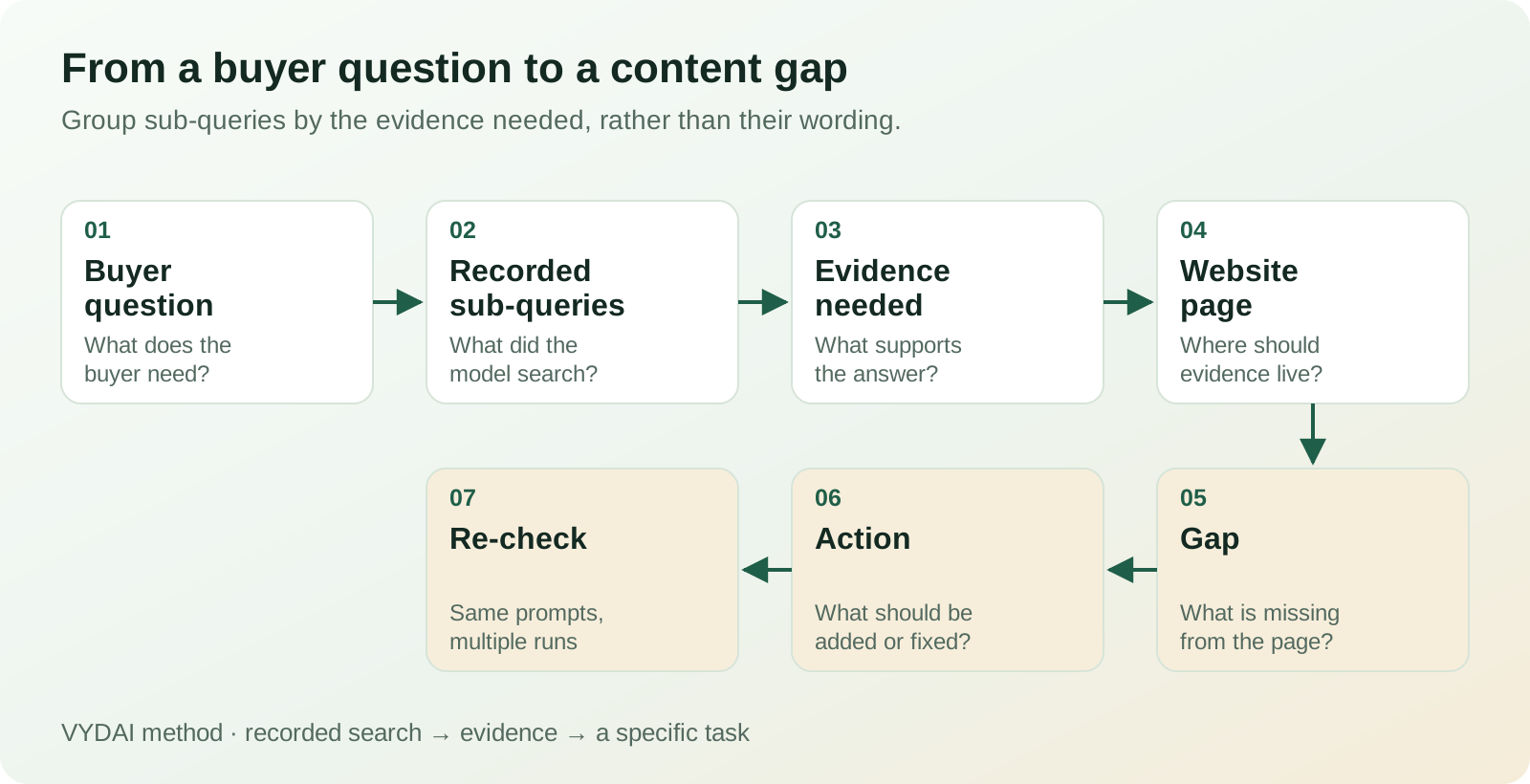
The matrix turns search strings into evidence checks. The recorded queries below come from VYDAI's API logs. A search string may be short or include a domain, so group rows by the buyer's evidence need.
| Buyer prompt | Recorded fan-out query theme, in English | Evidence the model needs | Where it belongs on the site | How to check the gap | Action |
|---|---|---|---|---|---|
| How much does the CRM cost? | KeyCRM pricing, price in dollars, and plan limits | Price, currency, plan limits, and current date | Pricing page | Find the amount as text in the HTML; check the URL is accessible and linked internally | Add or update the pricing table |
| Does it integrate with marketplaces? | Searches for Prom, Nova Poshta, Rozetka, and integration pages | Service name, integration type, and setup terms | Integration catalog and, when needed, pages for individual integrations | Open the page without JavaScript and check that Prom and Rozetka appear in text and the URL | Add a missing integration description |
| How do two products differ? | SalesDrive pricing and 2026 price searches | Comparable features, limits, and prices for both products | Feature and pricing pages; a comparison page if the business supports one | Verify claims about both products against their primary sources | Update the facts or publish a fair comparison |
| Is the product worth switching to based on reviews? | KeyCRM reviews on G2, Capterra, and YouTube | Reviews and experience outside the brand's site | Independent platforms; the company site can explain its review process | Open each result and check its date and author | Assign reputation work to the right team |
| Does the CRM work with Instagram? | Instagram Direct, CRM, and shipping integration searches | Channel support, feature limits, and setup | Feature or integration page | Check the use case and look for Instagram Direct in accessible page text | Describe the feature and link it from the catalog |
| Is there a free plan? | KeepinCRM free-plan and official pricing searches | Free plan terms, limits, and upgrade path | Pricing page or help center | Check that terms are text, not just an image, and are dated | State availability and limits |
| Where can I verify this is official information? | SalesDrive official-site and pricing searches | Consistent company and product names and a clear source page | Homepage, About page, pricing | Compare company and product names across pages | Resolve naming differences and add internal links |
| Can I try it before paying? | KeyCRM help-center searches for a 30-day trial | Trial length and terms | Pricing page or help center | Find the term in text and check the page date and availability | Update the help page and pricing page |
How to use query fan-out to find content gaps
Check whether the page answers the buyer's question, not whether it repeats a keyword. Open the page as a user would, find the evidence in its text, check whether it is current and indexed, and follow the internal links that lead to it. For search access, check robots.txt and the server response. See how to check AI crawler access to a page.
| Gap type | How to spot it | What to do |
|---|---|---|
| No page exists | No URL answers the buyer question | Add a page when the topic needs its own evidence |
| The fact is only in an image or widget | The price or term cannot be found in page text | Repeat key facts as ordinary text |
| The information is stale or undated | A price, feature, or term has no clear update date | Verify it and add an update date |
| Independent evidence is needed | The search points to reviews or third-party coverage | Improve profiles and external evidence; do not imitate it on your site |
| The page is blocked or hidden | The URL is blocked from search crawlers, noindexed, or has no internal links | Check access rules, indexation, and navigation |
| The URL is unclear | The model searches for /pricing but the pricing page has a less obvious path | Make the URL clear and link to it from related pages |
OpenAI's crawler documentation describes OAI-SearchBot as the crawler for ChatGPT search and says that after a robots.txt update, it can take about 24 hours for OpenAI's systems to adjust.
Should I create a page for every fan-out query?
No. Group query strings by the evidence the buyer needs. In the VYDAI test, 84 strings mentioned prices or tariffs and led to a handful of pricing pages; salesdrive.ua/prices/ alone was opened seven times. One complete pricing page can answer them. Create another URL when a substantial topic needs its own terms or proof, such as an integration with a specific marketplace. Reviews that the model finds on third-party sites belong to reputation work, not a company-written recap.
How to choose which content gaps to close first
Start with a theme that appears across buyer prompts and is close to a purchase decision. A practical order:
- Prioritize a theme that appeared in at least two of three runs and in at least two prompts.
- Next, take facts that affect the decision: pricing, integrations, a trial, or plan limits.
- Update information only the company can confirm first: prices, terms, and available features.
- Assign independent reviews to reputation or PR work instead of publishing another page that paraphrases other people's comments.
- Consider effort: updating an existing pricing page is usually simpler than creating a separate documentation section.
If the page already contains the fact, is accessible to search crawlers, and has internal links, check the citations and answer accuracy.
How to recheck after updating content
After updating a pricing or integration page, rerun the same prompts with the same model, language, location, and settings. Save the date and raw result for each run. Compare three things: whether the same sub-query theme appears, whether the model opens or cites the updated URL, and whether its answer states the fact correctly.
Use a regular schedule and compare runs under the same settings. If a URL does not appear, check that the page is accessible and contains the exact evidence. For a separate diagnosis of changes in citations over time, read why AI stopped citing your website.
Method limits
Responses API logs show what the API did with a specific tool, not the full internal history of the ChatGPT app. Sign-in, chat history, plan, personalization, location, and model changes affect how a search runs. Ahrefs measured one free mode during August and September 2026, while our test covered seven commercial prompts in Ukrainian, each repeated three times. It shows which pages to inspect in the CRM example, not search demand or behavior across every market and topic.
Frequently Asked Questions
How many searches does ChatGPT run?
In Ahrefs' study published October 12, 2026, responses that searched had about 1.6 fan-out queries on average across 66.6 million free, logged-out GPT-5.6 Luna responses.
Does ChatGPT always search the web?
No. Ahrefs found web search in 14.4% of 66.6 million free, logged-out GPT-5.6 Luna responses collected in August and September 2026.
Does ChatGPT show its search queries?
The app shows citations and a Sources panel, not the full list of queries. In the Responses API, you can save web_search_call actions and the queries array when the tool output includes it.
Why does ChatGPT add “official” to its searches?
For current prices, features, or terms, the company's own page can provide those facts. In the October 12, 2026 VYDAI test, 32 of 153 search strings included the Ukrainian word for “official” or the English word “official,” 24 in Ukrainian and 8 in English. In Ahrefs' English-language fan-out sample, the word official appeared more often in September than in August 2026.
What language does ChatGPT search in when I ask in Ukrainian?
In our test, Ukrainian prompts often included Latin-script CRM names, and the free-plan prompt added searches for international products.
How we do it in VYDAI
VYDAI tracks the prompts you add in ChatGPT, Gemini, Claude, Google AI Overviews, and AI Mode on a schedule. Its Sources report shows the domains and pages cited in answers, when each URL last appeared, and the prompt and system associated with that mention. After updating a pricing or integration page, you can check whether the URL appears among the sources for your test prompts.
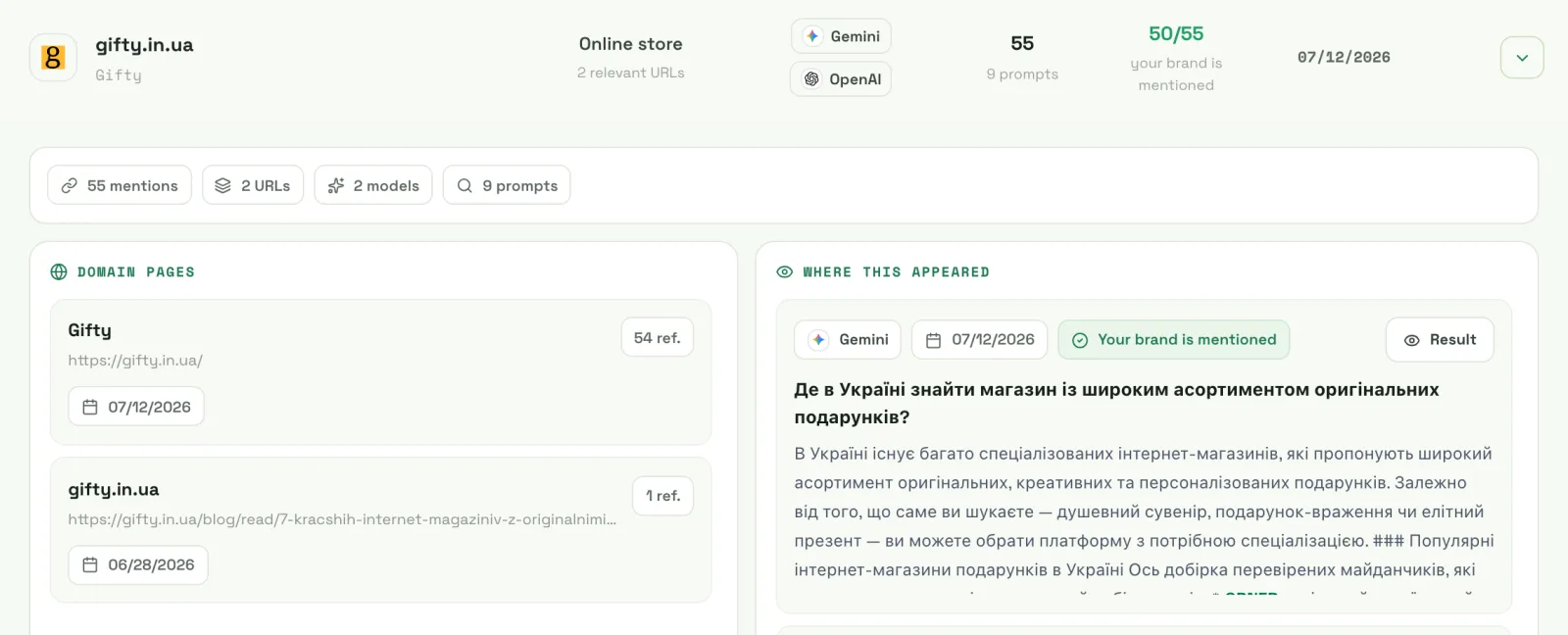
VYDAI stores answers and sources, but it does not show the sub-query strings a model ran during web search. For that audit, use API output or another log with a disclosed method. A small site can repeat a few important buyer prompts manually and track the results in a spreadsheet. If you need to compare citations by prompt, system, and date on a regular basis, view the VYDAI demo or create a workspace.